

About the Authors

We're Tom (33) and Sophie (31) — a Bath couple who launched BabyMade after becoming first-time parents to Freddie. Sophie's midwifery background and our shared obsession with finding genuinely good baby products turned into this blog. We write everything we wish we'd had when Freddie arrived.
Disclosure: This article contains affiliate links. If you buy through them we may earn a small commission at no extra cost to you. We only recommend products we genuinely rate.
Baby headbands are one of those things that split parents right down the middle. Half will tell you they're a non-negotiable part of every outfit and the other half will tell you they're pointless because they fall off immediately and the baby looks mildly annoyed within about four minutes. Both groups have a point.
The truth is that whether baby headbands work for you comes down almost entirely to two things: the style you choose and the fabric it's made from. A flimsy elastic headband from a pound shop will be on the floor before you've finished dressing your baby. A well-made soft nylon or jersey knotted headband will stay put, look gorgeous in photos, and genuinely become one of those finishing touches you reach for without thinking.
We've been through a lot of headbands with Freddie's cousins — and with the babies of friends who've consulted Sophie in her role as a midwife — so this guide is built on a lot of real-world trial and error. We cover every style, the safety rules that actually matter, how to get sizing right, and the specific picks that hold up in practice. For the full picture on dressing your baby from newborn onward, our baby clothing guide covers everything from babygrows to first shoes.
Why Baby Headbands Divide Parents (and Why Both Sides Are Right)
The anti-headband camp isn't wrong. A lot of baby headbands are genuinely rubbish — thin elastic that marks the skin, stiff bows that look rigid and uncomfortable, or sizes that just don't fit newborn heads properly. If your only experience of baby headbands is a multipack from a supermarket, the scepticism is understandable.
The pro-headband camp is equally correct. When you find a baby headband that actually works — soft enough to sit comfortably, stretchy enough to stay in place, well-made enough to look good — it becomes one of those small things that makes getting a baby dressed feel like more of an event. First photos. Christening morning. Coming home from the hospital. These are the moments where a beautiful headband earns its place.
The key insight is that baby headbands are not all the same, and buying based on price alone will always lead to disappointment. Spend a little more on quality materials and you'll end up with something that works properly — and that you'll actually use.
If you've decided headbands aren't quite right and you want something that covers the ears, blocks UV or actually stays on a wriggly six-month-old, our baby bonnet UK guide covers knit, cotton and sun bonnets — the chin-tie is what makes them stay put when a stretch headband can't.
Types of Baby Headband — Bow, Knotted, Elastic and Turban
There are four main styles of baby headband and they suit different babies, different occasions and different parents. Here's what you actually need to know about each one.
Bow headbands
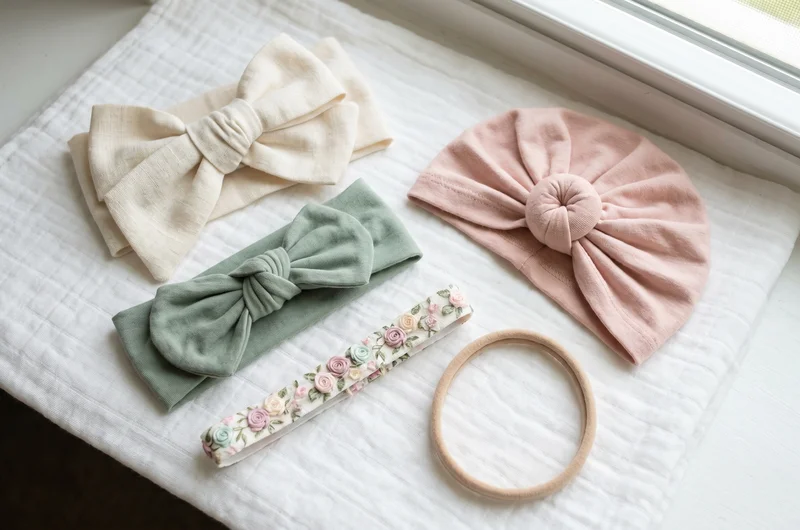
The large oversized bow headband is the style most people picture when they think of baby girl headbands. They make a big visual statement and photograph beautifully. The key quality marker is how the bow is attached — a securely sewn bow that can't detach is essential for babies who will be wearing it actively. Avoid large bows with wire or stiff interfacing inside; soft, floppy bows are both safer and more comfortable. Baby bow headbands come in a huge range of sizes and fabrics, but the nylon band variety tends to stay on best.
Knotted headbands
The knotted headband — a simple stretch band with a knot or gather at the front — is arguably the most practical style. It works on boys and girls, it stays on reliably, and it has a softness that looks expensive even when it isn't. Jersey cotton knotted headbands are a particular favourite because the knot gives them structure without any hard components. These are the ones that end up being used every day rather than just for special occasions.
Turban headbands
A wider, gathered style that covers more of the head — somewhere between a knotted headband and a soft hat. Turban headbands are enormously popular for newborn photography because they have a cosy, wrapped look that photographs beautifully. They also have a practical advantage: because they cover more surface area, they tend to stay put better than thinner styles. Great for newborns who still have patchy hair.
Simple elastic headbands
The basic stretched elastic band — sometimes with a small flower or bow attached. These are the cheapest option and also the most likely to leave marks if the elastic is too tight. If you go this route, choose styles where the elastic is soft and relatively wide (not thin cord elastic) and check that any attached decoration is genuinely secure. These work well as part of a larger set when you want variety without spending a lot.
Are Baby Headbands Safe for Newborns?
This is the question Sophie gets asked most by new parents, and the honest answer is: yes, with specific caveats. Baby headbands are safe when used correctly and the safety rules are straightforward.
Never use during sleep. This is the non-negotiable rule. Even the softest headband can shift during sleep and become a hazard. Headbands are for waking, supervised wear only — they come off at nap time and definitely at bedtime. This applies even to very young babies who seem unlikely to move much.
Check the fit every time. A headband that fitted perfectly last week might be too tight this week — babies' heads grow very quickly in the first months. The two-finger rule: you should be able to slide two fingers comfortably under the headband at any point. If you can't, it's too tight and needs to come off.
No hard parts near the skull. Any headband with a rigid frame, wire structure, or hard plastic component is not suitable for babies under 12 months. The skull is still developing and sustained pressure from hard objects is not appropriate. Stick to fully soft, flexible designs.
Midwife note: Many parents ask whether headbands can affect a baby's fontanelle. A well-fitted soft headband sits above and behind the fontanelle and poses no risk. The concern applies to tight, hard headbands placed directly over the soft spot — not to soft stretch headbands worn correctly.
What Size Baby Headband Fits a Newborn?
Baby head circumference at birth is typically 33–35 cm, growing to around 40–41 cm by 3 months and 44–46 cm by 12 months. Most baby headbands labelled "newborn" or "0–3 months" are designed to stretch comfortably across this range.
The thing that matters more than the age label is the stretch specification. A good soft nylon headband will stretch from around 32 cm to 50 cm — which means one headband can take you from the first week all the way through the first year without needing to size up. This is genuinely useful when you're buying in advance or buying as a gift.
When buying for a newborn specifically, look for headbands marketed for "0–3 months" or "newborn to 12 months" with a confirmed stretch range. Avoid "one size fits all" claims without supporting measurements — these often fit toddler heads well but are too loose for a newborn's smaller circumference and will fall off almost immediately.
The Best Fabrics for Baby Headbands
Fabric choice is the single biggest factor in whether a baby headband works or doesn't. Here's what to look for:
Soft nylon
The gold standard for baby headbands. Soft nylon has exceptional stretch, grips gently without being tight, and doesn't leave marks the way thin elastic does. It's also very durable — nylon headbands hold their shape wash after wash. The slight drawback is that nylon isn't as breathable as cotton, so in warm weather or for extended wear, cotton options are kinder.
Jersey cotton
The best all-round choice for babies with sensitive skin. Jersey cotton is soft, breathable, and washes beautifully. Knotted and turban styles in jersey cotton are particularly lovely — the fabric has a natural drape that makes them look more considered than basic elastic styles. The stretch isn't quite as good as nylon, so check the fit carefully for very young babies.
What to avoid
Stiff lace without a soft backing, thin cord elastic (marks easily), any fabric with scratchy texture, anything with embellishments that aren't fully secured, and wire or plastic frame headbands of any kind for babies under 12 months. When in doubt, if it doesn't feel soft against your own wrist, don't put it on a baby's head.
Our Top Baby Headband Picks UK 2026
These are the baby headbands that consistently get the best results in the UK — staying on, looking good, washing well and not leaving marks. We've covered every style so there's something here whatever you're looking for.
For babies who are going through a lot of headbands, a multipack is usually the most cost-effective route — you get variety in colour and style, and losing or ruining one isn't a disaster. Our baby clothing guide has more on building a practical first wardrobe alongside accessories like headbands.
Baby Headbands for Boys — Yes, Really
Baby headbands are almost universally marketed at girls, which means a lot of parents of baby boys never consider them. That's a shame, because knotted and turban headbands in neutral colours are genuinely lovely on baby boys and make a real difference in newborn photos.
The trick is to ignore the pink and bow-heavy listings and go straight to the neutral palette: grey, white, navy, olive green, camel and tan. A simple knotted jersey headband in grey or off-white on a newborn boy photographs beautifully and has none of the fussiness that puts people off. Several UK sellers now make specifically gender-neutral baby headband ranges, and these are worth seeking out.
If you're putting together a complete newborn outfit — pairing a headband with a soft baby romper or a knit baby bootie set — neutral headbands tie everything together without clashing. It's a small touch but it makes a visual difference, particularly in early photos when you're still working out what your baby looks like in different colours.
Baby Headbands for Christening, Hospital and First Photos

Certain occasions call for a specific kind of baby headband, and it's worth having the right one ready in advance rather than scrambling at the last minute.
Hospital and coming home
The hospital photo — the first proper picture of your baby — is one you'll look at for the rest of your life. A soft knotted or turban headband in white or cream is a classic choice that photographs beautifully without being overdressed. Pack one in your hospital bag; it takes up no space and makes the coming-home photos feel more considered. A matching baby dress or a soft knit set makes the full outfit feel complete.
Christening
For a christening, a white or ivory lace or satin bow headband is the traditional UK choice. These pair naturally with a christening gown or a white dress and have a formality that suits the occasion. Look for headbands with a delicate rather than oversized bow — something that feels elegant rather than theatrical. If you're giving a headband as a new baby gift, a beautiful christening headband presented alongside a keepsake box is a genuinely lovely combination.
Newborn photography sessions
For a professional newborn photoshoot, turban and knotted headbands are the photographer's choice — they create a wrapped, cocooned look that suits the styling common in newborn photography. Muted and earthy tones (blush, cream, sage, tan) work better than bright primaries in this context. Many newborn photographers will have a selection of props including headbands, but having your own means you control the style and have something to keep.
How to Keep a Baby Headband On
The most common complaint about baby headbands is that they slide off. Here's why it happens and how to fix it:
Wrong size. The most common cause. If the headband is too big for the head circumference, it will slide backward and fall off. Check the stretch range on the product and compare it to your baby's head measurement. If you're between sizes, size down — it's easier to stretch a slightly small headband than to keep a slightly large one in place.
Wrong style for the hair stage. On completely bald newborns, nylon headbands grip better than fabric ones because the nylon material has natural traction against skin. On babies with fine, wispy hair, knotted styles tend to stay put better than flat bands because the knot acts as an anchor point.
Wrong positioning. A headband placed right at the hairline has minimal surface contact and will move easily. Position it slightly back from the hairline — maybe 1–2 cm — which gives it more scalp contact and more grip. This works particularly well with turban styles.
The wrong fabric entirely. Thin cord elastic will always slide on fine baby hair. If you've tried all of the above and the headband still won't stay, switch to a soft nylon style — the slightly grippier material makes a genuine difference.
Where to Buy Baby Headbands in the UK
You have several good options depending on what you're after and how quickly you need them.
Amazon UK
The fastest and most varied source for baby headbands in the UK. Baby headbands on Amazon UK range from budget multipacks to premium single pieces. Filter by rating and focus on sellers with 200+ reviews — customer photos in reviews are far more reliable than listing images for working out whether a headband actually stays on and looks as described.
Etsy UK
Excellent for personalised baby headbands and unique designs from independent UK makers. If you want an embroidered name headband or something genuinely one-of-a-kind, Etsy is where to look. Lead times are longer — typically 5–10 days for personalised pieces — so plan ahead. Filter for UK sellers to avoid slow international shipping.
Not On The High Street
Strong for premium gift-quality baby headbands, particularly christening and special occasion pieces. The packaging tends to match the quality, which matters if you're giving as a gift. More expensive than Amazon but the presentation is noticeably better.
Whichever route you go, it's always worth buying a small set rather than a single headband first — different styles suit different babies and you won't know which one works until you try a few. For more on dressing babies from newborn to toddler, the baby clothing guide covers sizing, fabrics, seasonal dressing and the pieces that actually get used.