
About the Authors

We're Tom (33) and Sophie (31) — a Bath couple who launched BabyMade after becoming first-time parents to Freddie. Sophie's midwifery background and our shared obsession with finding genuinely good baby products turned into this blog. We write everything we wish we'd had when Freddie arrived.
Of all the things I thought I understood before having a baby, blankets felt like the most straightforward. A blanket is a blanket. You put it on the baby. Done.
And then I discovered that there are approximately seven hundred types of baby blanket, some of which are safe for sleep and some of which are not, some of which are practical and some of which are purely for the aesthetic of the nursery flatlay. I had a cellular blanket that I used religiously because the midwife told me to, three muslin squares that I used for absolutely everything, a gorgeous knitted one that I was too scared to wash in case it shrank, and a personalised embroidered one that lived in the memory box and never went near a cot.
If you're trying to work out which blankets you actually need — this is the guide I wish I'd had. We cover the lot: cellular baby blankets, muslin blankets, personalised baby blankets, cashmere, knitting patterns, designer options and the safety stuff that actually matters.
Safe sleep reminder: Loose blankets in a baby's sleep space are a suffocation risk. The Lullaby Trust recommends using a baby sleeping bag instead of loose blankets for night sleep. This guide covers both sleep-safe options and blankets for daytime use, supervised naps and gifting.
Baby Blanket Safety — What's Safe for Sleep
Let's get the most important bit out of the way first, because it genuinely matters.
The NHS and Lullaby Trust advise that the safest sleep environment for a baby is a firm, flat mattress with a fitted sheet — and nothing else loose in the sleep space. No pillows, no bumpers, no cuddly toys, and ideally no loose blankets either, particularly for babies under 12 months.
A baby sleeping bag (the wearable kind) is the recommended alternative to blankets for night sleep — it stays put, it doesn't bunch up over a baby's face, and it doesn't get kicked off and leave them cold. For everything you need to know about sleeping bags and TOG ratings, see our baby sleep guide.
That said, blankets are not entirely off the table for sleep. If you do use a blanket in a cot or moses basket:
- Use a lightweight, breathable blanket — cellular weave is the gold standard
- Tuck it firmly under the mattress on three sides so it can't ride up
- Place baby with their feet at the foot of the cot (so they can't wriggle under the blanket)
- Keep it below shoulder level — never over the baby's face or head
- Use only one layer — don't double up
Where blankets are brilliant and entirely safe: supervised daytime lounging and naps, the pram, the car seat (tucked in, not over a harness), tummy time, and as a gifting choice where they'll be used for wrapping, cuddling and photographing rather than unattended sleep.
Baby Blanket Sizes Guide
One of the most common questions when buying baby blankets is what size to get — because, as with baby clothes, the answer is "it depends" but in a slightly more useful way.
| Size | Typical dimensions | Best use |
|---|---|---|
| Muslin square | 70×70cm | Swaddling newborns, burp cloth, nursing cover, tummy time mat |
| Pram / moses basket | 75×100cm | Pram, moses basket, carrycot. The go-everywhere size. |
| Cot blanket | 100×120cm | Standard cot. Fits with room to tuck under the mattress. |
| Cot bed blanket | 120×150cm | Larger cot bed, toddler bed. Grows with the child. |
| Large swaddle / wrap | 120×120cm | Larger babies, outdoor wrapping, oversized muslin |
For gifting, a cot-sized blanket (around 100×75cm or 100×100cm) is the most versatile — it works in the pram when folded, fits a standard cot properly, and has enough longevity that it doesn't get outgrown in three months. If in doubt, go bigger — a slightly oversized blanket is always more useful than one that's too small.
Cellular Baby Blankets
If someone tells you to buy a cellular baby blanket and you don't know what that means, here's the simple version: it's a blanket woven in a distinctive open-hole pattern — like a very fine mesh or waffle texture. Those holes are the whole point. They allow air to circulate through the blanket, which means that if a baby does pull the blanket over their face, they can still breathe through it. It's the single most important safety feature a sleep blanket can have.
This is why cellular blankets are what the NHS recommends for babies under 12 months when blankets are used in sleep. They're the ones that midwives and health visitors mention. They're the ones that come in the hospital information packs. And for good reason — they're designed with safety built into the fabric itself.
Beyond safety, they're also brilliantly practical:
- Lightweight — they don't add bulk but do add warmth, and they layer well (two thin cellular blankets are safer and more flexible than one thick one)
- Machine washable at 60°C — most are, which is essential for anything going near a baby
- Affordable — basic cellular blankets start at around £5–£12 each, and multipacks are good value
- Available in soft colours — they're not the most glamorous blanket, but they come in a good range of pastels and whites that work with any nursery
Buy at least two or three — they go through the wash frequently. White or cream cellular blankets are the most practical (easier to see if they're properly clean and no colour fading over time).
Muslin Baby Blankets
If the cellular blanket is the safety hero of baby blankets, the muslin is the utility player that does absolutely everything else. I had about twelve of them by the time my second was born — not because I planned it that way, but because I kept buying more every time I realised how many ways you actually use them.
What muslin baby blankets are actually used for (the full list, because nobody tells you this upfront):
- Swaddling newborns — the lightweight, slightly stretchy fabric is ideal for swaddles that aren't too stiff or too hot
- Burp cloth — draped over your shoulder for every single feed, because babies are chaotic
- Sun shade for the pram — draped loosely over the hood, it reduces sun glare without blocking airflow (unlike proper covers, which can overheat babies)
- Nursing cover — if you're breastfeeding in public and want a bit of privacy, a large muslin works perfectly
- Tummy time mat — something soft and familiar to put baby on
- Emergency changing mat — because you will at some point find yourself without one
- Makeshift bib — tied loosely around the neck if you're at someone's house and have forgotten the actual bibs
- Comfort object — many babies develop an attachment to a particular muslin's texture and smell. Some parents sleep with a muslin before giving it to the baby so it carries their scent — a genuinely useful tip for settl a baby who resists putting down.
What size muslin to buy
The standard muslin square (70×70cm) is the most versatile for newborns. But the larger large muslin blankets (around 120×120cm) are genuinely more useful once you're past the newborn phase — they're big enough to use as a proper swaddle for a larger baby, work as a lightweight blanket in the pram during summer, and double as a play mat. Buy both sizes and you won't regret it.
Bamboo muslin is worth mentioning: bamboo muslin blankets are softer than standard cotton muslin, naturally antibacterial, and brilliant for babies with sensitive skin or eczema. They cost a bit more but are noticeably nicer to the touch — worth it if you're buying a gift.
Personalised Baby Blankets
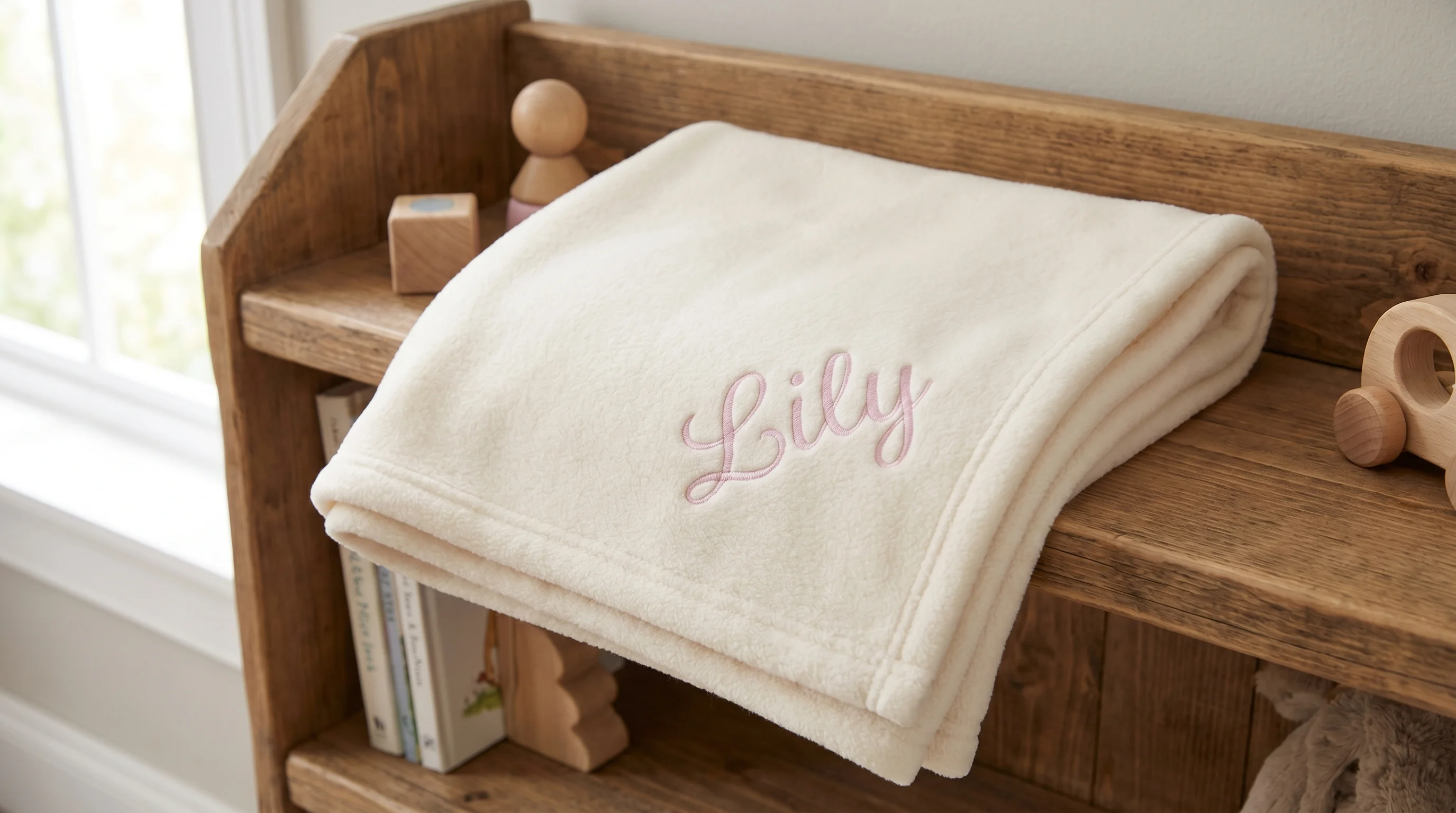
Personalised baby blankets are the single most searched personalised baby gift in the UK — and they're popular for very good reason. A soft blanket with the baby's name embroidered on it manages to be both practical (babies do need blankets) and genuinely sentimental — the kind of thing that gets kept in a box long after the baby has grown up.
These are the blankets that end up in the first photos, draped over the baby for the birth announcement shot. They're what grandparents frame. They're what parents take out of boxes years later and feel a wave of something they can't quite name.
Embroidered vs. printed personalised blankets
- Embroidered personalised baby blankets — the name is stitched directly into the fabric. More premium, more durable, washes better, looks beautiful. Prices typically start around £20–£40 depending on quality and size. These are the ones that become proper keepsakes — the embroidery doesn't fade or peel after washing the way printed designs can.
- Printed personalised blankets — the name is applied via heat transfer or sublimation printing. More affordable (typically £10–£25), wider variety of designs, faster to produce. Perfectly nice as a gift; just be aware that the personalisation is more prone to fading over time, especially with repeated high-temperature washing.
What to personalise with
Most sellers offer: name only (clean and classic), name and birth date (great for a newborn gift), name and a motif (an elephant, star, rainbow, cloud — choose one that works with the nursery theme), or a short phrase. Name-only tends to age the best — it's the detail that remains meaningful as the child grows, rather than a design that feels very "newborn" when they're a toddler.
Luxury personalised baby blankets — those with a higher-quality base fabric (cotton knit, velboa, bamboo blend) and high-stitch-count embroidery — are worth the extra spend for a gift. The difference between a £15 personalised blanket and a £35 one is very visible when you hold them side by side.
For more on personalised gifts beyond blankets, see our full personalised baby gifts guide.
If personalised blankets are what you're specifically looking for — with a dedicated breakdown of embroidered vs. printed, the best fabrics for newborns, gifting tips and lead times — we've covered it all in our dedicated personalised baby blankets guide.
Luxury & Cashmere Baby Blankets
There's a version of baby blanket buying that happens when you've been to the shops, priced up the cellular ones, put three in your basket and then spotted the cashmere section and just stood there for a moment, calculator in hand, trying to justify it.
Here's the thing: a cashmere baby blanket is genuinely extraordinarily soft. The finest cashmere is softer than most fabrics your baby will ever encounter — softer than cotton, softer than bamboo, softer than anything in the standard baby aisle. For a newborn whose skin is at its most sensitive and reactive, that softness isn't just nice; it's actually meaningful.
That said, cashmere is expensive, and most parents aren't going to use it as the everyday pram blanket that comes out in all weathers and goes in the washing machine at 60°C. Cashmere baby blankets tend to be for special occasions, for the newborn photos, for when Grandma comes to visit. They need careful washing (usually hand wash or delicate cycle, cool water, laid flat to dry). Whether that's worth it is a personal call — but as a gift at a higher budget, it's very hard to beat.
A slightly more practical middle ground: merino wool baby blankets. Merino baby blankets are incredibly soft (fine merino doesn't itch the way standard wool does), naturally thermoregulating (warm in winter, surprisingly cool in summer), and more durable than cashmere. They can often be machine washed on a wool cycle, which is far more practical. For parents who want the quality of a luxury blanket without the full cashmere price tag or care requirements, merino is the answer.
The other fibre worth a serious look in this price bracket is baby alpaca. It's silky-soft, hypoallergenic, warmer than wool without the bulk, and genuinely heirloom-quality — the kind of blanket that gets handed down. Our baby alpaca guide compares it directly with cashmere and merino so you can decide which makes sense for your budget.
Designer baby blankets — from brands like Aden + Anais, Jellycat, or premium gift brands — occupy the same space. These are often beautifully packaged and presented, which makes them particularly lovely as gifts.
Knitted Baby Blankets
A knitted baby blanket is one of those gifts that carries a particular kind of weight — especially if it's been made by hand. There's a reason they get kept. Something about the time and care that went into every stitch makes them feel different from anything you can buy off a shelf.
Whether you're buying or making one, here's what to look for:
Buying a knitted baby blanket
- Yarn softness: The most important factor. Baby skin is sensitive. A blanket that feels perfectly fine to adult hands might be itchy against newborn skin. Look for merino, cotton, bamboo or specifically labelled "baby soft" acrylic (modern baby acrylics are much softer than the scratchy ones from 30 years ago).
- Hole size in the knit: Very open-stitch patterns create holes that tiny fingers and toes can get caught in. A tighter knit or smaller hole pattern is safer for young babies.
- Washing instructions: If it's going to be used regularly, it needs to be machine washable. A blanket that requires hand washing will be less used than one you can shove in the machine.
- UK-made or fair trade: For a gift, knowing where it was made adds something. There are excellent UK-based knitters and small sellers on Amazon who make to order.
Free Knitting Patterns for Baby Blankets
If you knit — or if you want to learn — a baby blanket is one of the most satisfying things you can make. They're flat, they don't require shaping or complex construction, and they're genuinely useful and loved. The best bit: there are hundreds of excellent free knitting patterns for baby blankets available, ranging from beginner-friendly to genuinely complex.
Free baby blanket knitting patterns for beginners
If you're a beginner, the key is finding a pattern that uses only knit stitch or a simple knit-and-purl combination — no cables, no lace, no complex stitch counts. The classic garter stitch blanket (every row is knit stitch) is genuinely beautiful in a chunky yarn and requires no pattern at all — just cast on, knit every row until it's the size you want, cast off. That's it. Brilliant for a first project.
Good places to find free knitting patterns for baby blankets online:
- Ravelry — the largest knitting pattern database in the world, with filters for difficulty level, yarn weight and stitch type. Free patterns are clearly marked.
- Drops Design — a Norwegian yarn brand with an enormous free pattern library, including many baby blankets. Well-written patterns at all levels.
- LoveKnitting / Lovecrafts — UK-based, good selection of free and paid patterns, often with video tutorials alongside.
- Pinterest — search "free baby blanket knitting pattern PDF" for a huge range. Quality varies, so look for patterns with a lot of saves and positive comments.
Choosing the right yarn
For a baby blanket, the best yarn choices are:
- 100% merino wool — soft, warm, natural. Look for superwash merino so it can be machine washed.
- Cotton or cotton-blend — cooler than wool, hypoallergenic, good for babies with sensitive skin or eczema.
- Baby-specific acrylic (like Bernat Baby Blanket yarn) — Bernat Baby Blanket yarn is incredibly popular for baby blanket knitting — it's chunky, soft, machine washable and knits up very quickly. A full blanket can be done in a weekend.
- Bamboo blend — silky soft, breathable, naturally antibacterial. Slightly more expensive but lovely to knit with and beautiful to touch.
The best yarn for a baby blanket depends on what the blanket will be used for. For a practical everyday blanket, machine-washable acrylic or cotton is the most sensible. For a gift or heirloom piece, merino or bamboo elevates it significantly.
Crochet Baby Blanket Patterns
Crochet blankets are different in texture to knitted ones — they tend to be slightly thicker, more structured, and have a characteristic look that's immediately recognisable. They're also, if anything, slightly faster to make than knitted blankets at the same size, because each crochet stitch is taller than a knit stitch.
For beginners, a simple crochet baby blanket pattern using only treble crochet (the UK term — that's double crochet in US pattern terminology, which causes no end of confusion) creates a beautiful result quickly. If you can chain, single crochet and treble crochet, you have everything you need for probably 80% of baby blanket patterns.
Good beginner crochet baby blanket patterns to look for:
- Granny square blanket — make individual squares, join them together. Very forgiving for beginners, and the modular nature means you can do it in small bursts rather than needing long stretches of time.
- C2C (corner to corner) blanket — worked diagonally, creates a beautiful textured finish. Slightly more complex but incredibly satisfying and very popular.
- Simple striped blanket — the most beginner-friendly option. Chain your width, work in rows, change colour. No technique beyond basic stitches.
The yarn advice is the same as for knitting — soft, machine-washable, and ideally natural fibre or a high-quality baby acrylic. Chunky weight yarn works up fastest and looks great in crochet.
Pram & Pushchair Blankets
A pram blanket lives a hard life. It gets tucked and untucked a hundred times, dragged along pavements, sat on in coffee shops, left in the bottom of the changing bag, and washed on rotation. It needs to be warm enough to actually do its job, durable enough to survive all of the above, and compact enough to fold neatly in the pram hood.
Key things to look for in a pram blanket:
- Size: Around 75×100cm is ideal — big enough to tuck in properly on both sides, small enough to fold away easily.
- Attachment: Some pram blankets have press studs or loops to attach to the pram frame so they don't fall off. These are genuinely useful, especially once the baby is older and starts pulling at things.
- Material for the season: A summer pram blanket wants to be lightweight muslin or thin cotton. A winter one wants to be fleece, wool or a padded quilt-style. Having one of each is more practical than a mid-weight one that isn't quite right for either season.
- Machine washable: Non-negotiable. It will be filthy regularly.
One important safety note: never use a blanket tucked over a baby's car seat harness — it prevents the harness from working properly in a collision. In the car, put the blanket over the baby once they're strapped in, not underneath the harness. In the pram, blankets are fine but shouldn't cover a very young baby's face.
Designer Baby Blankets
For certain gifting occasions — a first baby, a close friend, a gift that needs to make a proper impression — a designer baby blanket from a well-known brand is worth considering.
The most popular designer baby blanket brands in the UK:
- Peter Rabbit baby blankets — a genuinely timeless British classic. Beatrix Potter's designs have been on baby blankets for decades and still sell consistently. Beloved by grandparents and new parents alike. The blue or pink Peter Rabbit blankets are the most popular.
- Jellycat baby blankets — the brand behind those iconic soft toys has a lovely range of blankets, often matching their most popular characters. Very giftable and beautifully soft.
- Aden + Anais — known for their beautifully printed muslin blankets in large sizes. Soft, breathable, and the patterns are genuinely lovely. Popular with parents who want something more stylish than the standard baby-pastel aesthetic.
- Miffy baby blankets — the simple, graphic Miffy aesthetic works beautifully on blankets. Grey and white pairs with virtually any nursery colour scheme.
Choosing a Baby Blanket as a Gift
A blanket is one of the most consistently well-received baby gifts — which is why it's worth spending a few minutes choosing the right one rather than just grabbing the first one you see.
Here's a quick decision guide depending on your budget and who you're buying for:
- For a close friend or family member, budget £30–£50: A personalised embroidered blanket with the baby's name. Soft, beautiful, and the most-kept gift you can give. Check lead times — usually 3–7 working days to produce.
- For a baby shower group gift, budget pooled: A cashmere or merino luxury blanket at a higher price point. The kind of thing new parents wouldn't buy for themselves but will absolutely treasure.
- For an acquaintance or colleague, budget £15–£25: A beautiful Peter Rabbit or Miffy knitted blanket, or a set of large bamboo muslin blankets in a pretty gift box. Safe, well-received, and genuinely useful.
- If the name is already announced: Go personalised. Every time.
- If you don't know the gender or the name: Stick to neutral colours — cream, grey, sage green, natural — and choose a non-personalised design. Or buy a personalised blanket with just the surname if that's known.
Looking for more gift ideas? See our full personalised baby gifts guide — including personalised keepsake boxes, teddies, grows and books — and our baby shower guide for gift-giving at a shower.