
About the Authors

We're Tom (33) and Sophie (31) — a Bath couple who launched BabyMade after becoming first-time parents to Freddie. Sophie's midwifery background and our shared obsession with finding genuinely good baby products turned into this blog. We write everything we wish we'd had when Freddie arrived.
Disclosure: This article contains affiliate links. If you buy through them we may earn a small commission at no extra cost to you. We only recommend products we genuinely rate.
When Freddie was about three weeks old, Sophie came home from a health visitor appointment having been told to "just use a simple fragrance-free moisturiser" on the dry patches appearing on his cheeks. Simple. Right. We spent the next hour in a pharmacy reading the back of every baby cream on the shelf, then another hour googling ingredients we couldn't pronounce. Not exactly what you want to be doing on four hours of sleep.
We eventually landed on Sebamed Baby Facial Cream Protective Care 50ml, partly because the pH claim made sense to us (more on that below), partly because Sophie had seen it recommended in a midwifery context, and partly because we were absolutely done reading labels. Freddie's cheeks cleared up within a week. We've used it consistently since and recommended it to more new parents than we can count.
This is our honest review — what the cream actually does, who it's genuinely good for, how it stacks up against alternatives, and whether the price is justified. For the broader context of building a good baby bedtime routine around products like this, our full baby sleep guide covers everything from bath time through to settling.
What Is Sebamed Baby Facial Cream Protective Care?
Sebamed baby facial cream is a daily moisturising and protective face cream designed for babies and young children. The 50ml tube is the standard size — small enough to sit in a changing bag, large enough to last a good few weeks of daily use. It is made by Sebamed, a German pharmaceutical skincare brand that has been producing pH-balanced skin products since the 1960s.
The "protective care" part of the name refers to its primary function: it forms a light protective film over the skin that helps guard against wind, cold air and general environmental dryness — the things that make baby cheeks red and chapped in autumn and winter. It is not a treatment cream (it is not medicated) and it is not a sunscreen, but it is a solid all-year daily moisturiser that is safe for newborn skin from day one.
The full range of Sebamed baby products includes washes, lotions, body cream and shampoo — all formulated at the same pH 5.5. The facial cream specifically is the one parents most often ask about because baby faces are the most exposed part of their skin and the most visible when things go wrong.
Why pH 5.5 Matters More Than You'd Think
Baby skin has a natural pH of around 5.5 — slightly acidic. This acid mantle, as it is called, is the skin's first line of defence against bacteria, irritants and moisture loss. It is not just a nice-to-have; it is the mechanism by which healthy skin protects itself.
Most conventional soap-based products — including many baby washes and creams — have a pH of 7 or above, which is neutral to alkaline. Applying alkaline products regularly disrupts the acid mantle and raises the skin's pH. Over time, this can lead to dryness, increased sensitivity and a weakened barrier that is more susceptible to irritants and bacterial infection. This is part of why some babies develop reactive skin despite being bathed with products marketed as "gentle."
Sebamed's pH 5.5 formulation is designed to match the skin rather than strip it. The practical effect is that it supports the skin barrier rather than working against it. For most babies this makes a noticeable difference — less redness, less dryness, fewer flare-ups — and for babies with particularly sensitive or eczema-prone skin, it can be genuinely significant.
This is not unique to Sebamed — other brands like CeraVe also focus on barrier support — but Sebamed's consistent application of this principle across their whole range makes it a coherent system rather than a single product claim.
Ingredients Breakdown — What UK Parents Should Know
Reading the ingredient list on a baby product can feel like homework. Here is what matters in the Sebamed baby facial cream 50ml formulation:
- No fragrance — fragrance (listed as "parfum") is one of the most common skin irritants in cosmetic products and is implicated in contact dermatitis. Sebamed baby facial cream contains none.
- No parabens — a preservative class that has been the subject of ongoing debate. Sebamed's baby range is paraben-free.
- No colourants — purely aesthetic additives with no skincare benefit and potential irritant risk. Not present.
- No alcohol — drying and irritating for immature skin. Not present in this formulation.
- Panthenol (Pro-Vitamin B5) — a well-established skin conditioning agent. It improves moisture retention, supports skin barrier repair and has a mild anti-inflammatory effect. This is one of the ingredients doing the actual work in this cream.
- Allantoin — soothing, moisturising and mildly keratolytic (helps with dry, flaky skin). Naturally derived from comfrey and widely used in sensitive skin formulations.
- Glycerin — a humectant that draws water into the skin from the environment. Highly effective, well tolerated and present in virtually every good moisturiser.
The full INCI list is available on the packaging and Sebamed's website. There is nothing in this formulation that would raise concerns for the vast majority of babies, including newborns.
Is Sebamed Baby Facial Cream Safe for Newborns?
Yes — unequivocally. Sebamed baby facial cream protective care is designed for use from birth. It has been dermatologically and paediatrically tested, and the formulation (fragrance-free, alcohol-free, paraben-free, pH 5.5) is specifically built around the requirements of newborn skin.
That said, the NHS advises keeping skincare products to a minimum in the first few weeks — newborn skin is still adapting to the outside environment, and for most healthy babies, plain water is sufficient for the face during that period. If your newborn has dry patches, wind chap or visible irritation, that is when a product like this comes into its own. We started using it on Freddie at about three weeks, which is pretty typical.
As with any new product on a baby's skin, apply a small test amount to a small area first and wait 24 hours before using more widely. Reactions to Sebamed baby facial cream are rare, but every baby is different.
How to Use Sebamed Baby Facial Cream Day-to-Day
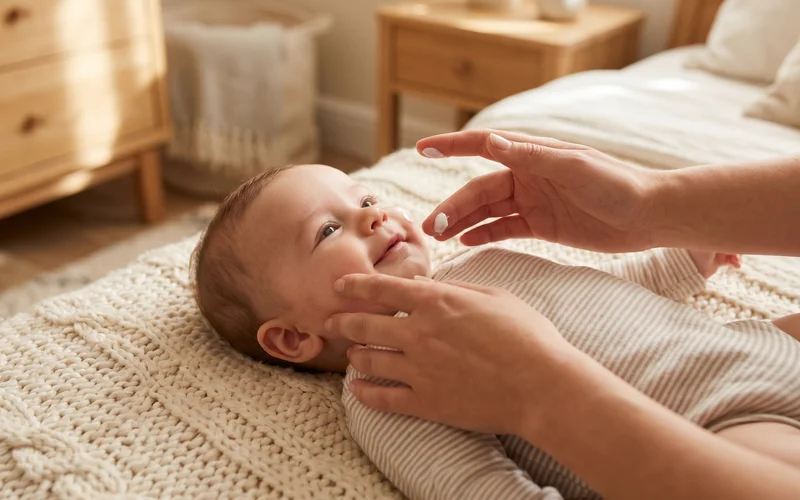
Using the cream is genuinely straightforward — it does not require any particular technique. Here is what works for us and what we tell other parents:
- Amount: A pea-sized amount is enough for the whole face. You do not need to use more than this — the cream is rich enough that more does not mean better, and overapplication can feel greasy.
- Timing: Apply after bath time as part of the bedtime routine, and in the morning if your baby has particularly dry or reactive skin. In cold or windy weather, applying before going outside creates a protective barrier against wind chap.
- Technique: Dot small amounts on the forehead, cheeks, nose and chin, then gently blend with fingertips using circular motions. Avoid the eye area and inside the nostrils. Most babies tolerate this very well — the cream absorbs quickly and does not leave a heavy residue.
- Frequency: Once or twice daily is typical. There is no need to apply after every nappy change unless your baby's face is particularly dry.
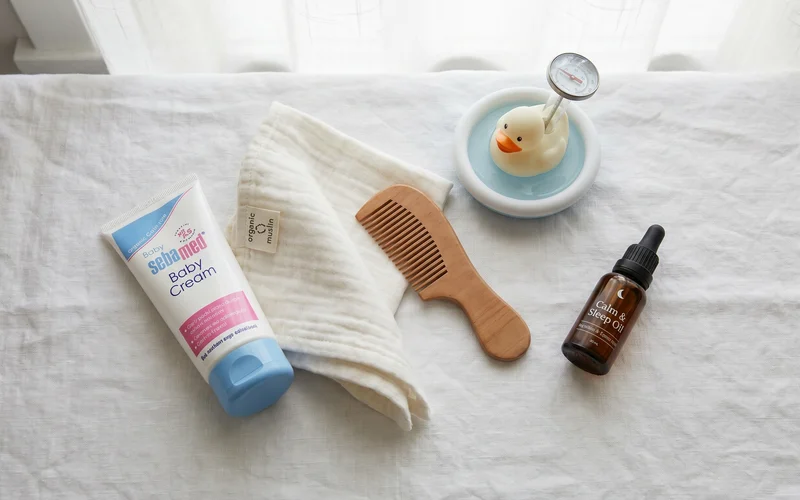
It works well alongside the rest of the Sebamed baby range — using the same pH-balanced wash and body cream keeps the whole skincare routine consistent. If you want a full bath time setup that matches, our review of Cetaphil baby wash covers the closest mainstream alternative to Sebamed's wash, and our baby bath thermometer guide covers getting the water temperature exactly right before bath time.
Sebamed Baby Facial Cream for Eczema and Dry Patches
This is probably the question we get asked most. The honest answer: Sebamed baby facial cream is not a treatment for eczema, but it is a very good daily moisturiser for eczema-prone skin, and there is a meaningful difference between those two things.
Atopic eczema in babies is a condition that requires medical management — if your baby has diagnosed eczema, your GP or dermatologist will prescribe emollients and, where necessary, topical steroids. What Sebamed provides is a daily maintenance layer that supports the skin barrier in between flare-ups. Because it avoids the most common irritant triggers (fragrance, colourants, alcohol), it is less likely to aggravate sensitive skin than most conventional baby creams.
Several parents in our community have told us they use Sebamed baby facial cream as their first-line daily moisturiser and reach for prescribed treatment only during active flare-ups. That is a reasonable approach and one that many dermatologists would endorse — the goal of daily emollient use is to maintain the barrier and reduce the frequency and severity of flares, not to eliminate them entirely.
For dry patches specifically — the red, flaky patches that appear on many babies' cheeks in winter — Sebamed tends to work well within a few days of consistent application. The panthenol and allantoin combination is good for this.
How Does It Compare to Other Baby Face Creams in the UK?
There is no shortage of baby facial creams and moisturisers in the UK. Here is how Sebamed compares to the main alternatives:
- Mustela Hydra Bébé Facial Cream — the most direct competitor. Also fragrance-free, also designed for newborns. Uses avocado perseose as its key active. Slightly lighter texture than Sebamed, similarly priced. A genuinely good alternative — personal preference tends to dictate which one parents stick with.
- Weleda Calendula Baby Face Cream — natural formulation based on calendula. Does contain a light natural fragrance from the plant extract, which may not suit the most reactive skin. Loved by many parents who prefer a more natural approach.
- Aveeno Baby Daily Moisturising Lotion — oat-based formula, very gentle and well tolerated. More of a body lotion than a dedicated face cream, but many parents use it on the face. Widely available in UK supermarkets. Very good value.
- CeraVe Baby Moisturising Lotion — ceramide-focused formula with a strong skin barrier rationale. More widely known in the US but increasingly available in the UK. Excellent for eczema-prone skin. Not specifically marketed as a face cream but safe to use on the face.
- Own-brand pharmacy options (Boots, Superdrug) — variable quality. Some are perfectly adequate; others contain fragrance or colourants that undermine their "gentle" positioning. Always read the label.
Sebamed sits at the premium end of this group — not the most expensive, but noticeably pricier than Aveeno or Boots own brand. The pH 5.5 guarantee and the clean ingredient profile are what justify that difference for most parents who choose it.
Can You Use Sebamed Baby Facial Cream on the Body Too?
Technically yes — there is nothing in the formulation that makes it unsafe for use on the body. The reason it is marketed specifically as a facial cream is texture and cost rather than any meaningful restriction. The face cream is slightly richer and more protective than the Sebamed baby lotion, which is designed for the body and is a lighter application that covers more surface area per application.
If you run out of body moisturiser and want to use the face cream in the interim, that is completely fine. But using a 50ml face cream as your primary body moisturiser would be expensive and impractical. The Sebamed baby lotion is the more practical and economical choice for full-body use — it is the same pH 5.5 formulation in a larger pump bottle.
How Long Does a 50ml Tube Last — Is It Good Value?
At a pea-sized application once or twice daily, a 50ml tube of Sebamed baby facial cream typically lasts four to six weeks. If you are applying once daily you are looking at the longer end of that range; twice daily use gets you closer to four weeks.
At current UK prices (typically £5–£8 per tube depending on where you buy it), that works out to roughly £1–£2 per week — which is not a significant outgoing. The cost becomes more relevant if you are comparing against much cheaper options like Aveeno or Boots own brand, which can be considerably less per use. The question is whether the pH-matched formulation and ingredient profile make up the difference for your baby's specific skin.
If you get on well with Sebamed, buying two or three tubes at once from the supermarket or online usually brings the unit price down slightly. The cream has a long shelf life unopened, so stocking up is a sensible move.
Where to Buy Sebamed Baby Facial Cream 50ml in the UK
Sebamed is well distributed in the UK. You can find it in:
- Boots — both in store and online. Often on promotion. The most convenient option for most UK parents.
- Tesco and Waitrose — selective stores stock Sebamed baby products. Worth checking your local store if you prefer to buy in person.
- Amazon — reliable availability, often the best price, especially when buying multiple tubes. Search Sebamed baby facial cream on Amazon to compare current prices and pack options.
- Superdrug — stocks selected Sebamed products online. Price is typically similar to Boots.
- Pharmacies — independent pharmacies sometimes stock Sebamed, particularly in areas with higher demand for dermatological products.
Avoid buying from unknown third-party sellers on marketplaces at heavily discounted prices — counterfeit skincare products do circulate online, and baby products are not immune. Stick to established retailers or official Amazon listings from the brand itself.
What UK Parents Actually Say About It
We have been recommending Sebamed baby facial cream to parents in our community for a couple of years now. Here is the consistent picture that comes back:
- Winter wind chap — the most reliable positive feedback. Parents who apply it before pram walks in cold weather consistently report fewer red, dry cheeks. This is probably the single use case where you notice the difference most quickly.
- Newborn dry skin — the dry, peeling skin that appears on many newborns in the first few weeks (completely normal, by the way — it is just the vernix wearing off) responds well to daily application.
- Sensitive or reactive skin — parents of babies who react to almost everything else often find Sebamed is one of the few products their baby tolerates. The clean formulation makes the elimination of variables straightforward.
- Texture — the cream absorbs more quickly than some alternatives (Weleda calendula, for example, can feel quite heavy). Most parents find it sits on the skin well without feeling greasy.
- The tube — small criticism from several parents: the 50ml tube is hard to squeeze near the end. Not a dealbreaker but worth noting if you dislike the frustration of trying to get the last bit out.
Our Honest Verdict — Worth It or Not?
Yes — with the caveat that what "worth it" means depends on your baby's skin. If your baby has perfectly happy, trouble-free skin and you are using a gentle fragrance-free moisturiser already, switching to Sebamed is unlikely to produce a dramatic improvement. The NHS recommendation for healthy baby skin is simple and minimal, and that holds.
But if your baby has dry patches, sensitive or reactive skin, or eczema-prone tendencies, Sebamed baby facial cream protective care 50ml is one of the most robustly formulated options in the UK market. The pH 5.5 rationale is grounded in real dermatology, the ingredient list is genuinely clean, and the texture works well for daily face use. We would buy it again without hesitation.
It slots naturally into the post-bath step of a bedtime routine — face cream after the bath, before the feed and settle. It takes about 30 seconds to apply and, for babies whose skin benefits from it, the difference shows quickly. That is a pretty good return on a small tube of cream.