
About the Authors

We're Tom (33) and Sophie (31) — a Bath couple who launched BabyMade after becoming first-time parents to Freddie. Sophie's midwifery background and our shared obsession with finding genuinely good baby products turned into this blog. We write everything we wish we'd had when Freddie arrived.
Disclosure: This article contains affiliate links. If you buy through them we may earn a small commission at no extra cost to you. We only recommend products we genuinely rate.
Someone in our NCT group mentioned bone marrow at weaning and half the room looked at her like she'd suggested feeding Freddie a raw steak. The other half immediately grabbed their phones to Google it. We were in the second group — and within a week, bone marrow had become one of the easiest, most enthusiastically received first foods we'd offered. We tell everyone about it now.
It sounds niche, but bone marrow for babies has proper nutritional backing behind it. It is rich in healthy fats, fat-soluble vitamins, collagen and easily absorbed minerals — and the taste is mild, slightly savoury, and apparently very appealing to babies who haven't yet been exposed to ultra-processed food flavours. Freddie ate it off a spoon at six months with the look of someone who had just discovered something very important. He wasn't wrong.
This guide covers everything you need to know: what bone marrow actually is, when to introduce it, how to cook it safely, how to serve it for both baby-led weaning and spoon-fed babies, and what to watch out for. Everything in our complete baby feeding guide applies here too — bone marrow is just one part of building a varied, nutrient-rich weaning diet.
What Is Bone Marrow and Why Are Parents So Keen on It?
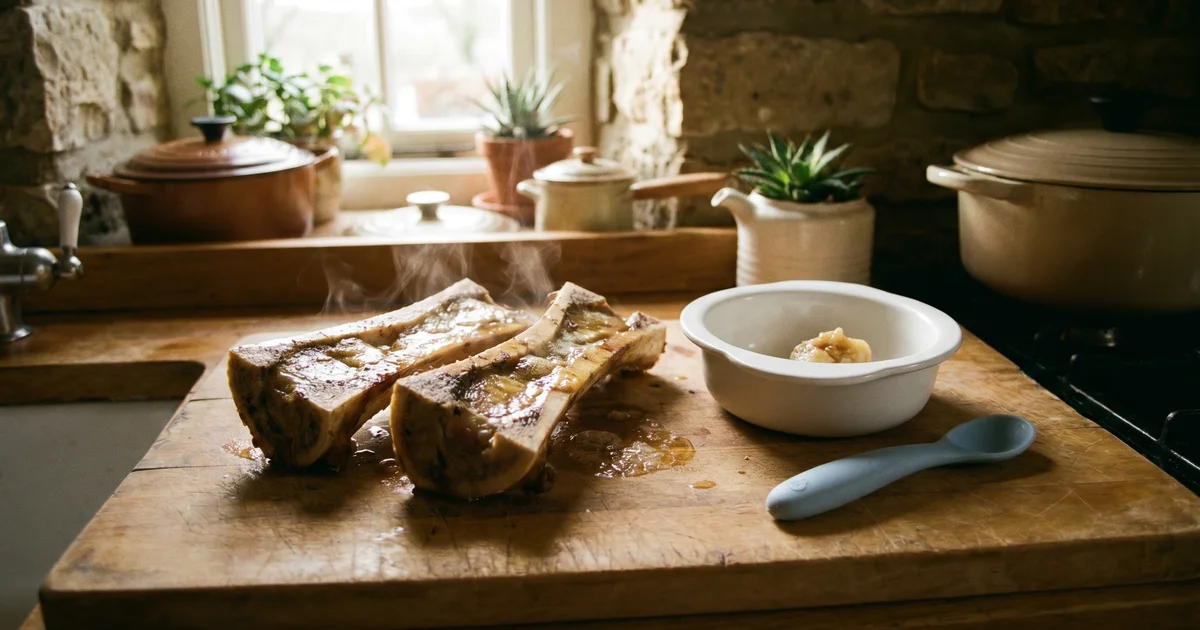
Bone marrow is the soft, fatty tissue that sits inside large animal bones — typically beef or lamb. In cooking terms, it's usually prepared by roasting halved marrow bones in the oven until the marrow inside turns soft and starts to pull away from the bone slightly. You then scoop it out with a small spoon.
It has long been a traditional food in many cultures — cooked as part of slow-cooked stews, spread on toast in upmarket restaurants, or simmered into broths. What's changed recently is that a growing number of parents in the UK have started introducing it as a weaning food, particularly those following a nose-to-tail or nutrient-dense approach to feeding. The logic is simple: it's a whole food, it contains a concentrated hit of things babies genuinely need, and it's about as unprocessed as food gets.
Is Bone Marrow Safe for Babies?
Yes — bone marrow is safe for babies from around 6 months, provided it is fully cooked and cooled before serving. There are no known allergens associated with beef or lamb marrow, making it one of the lower-risk animal foods to introduce. As with any new food, offer a small amount first and watch your baby for any reaction over the following 24 hours, though reactions to bone marrow are genuinely rare.
A few things to be clear on:
- No added salt — babies under 12 months should have less than 1g of salt per day. Don't season the bones at all before roasting.
- Make sure it's fully cooked — raw marrow carries bacteria risk like any raw meat product. Roast it until it is soft, wobbly and slightly translucent all the way through.
- Cool completely before serving — marrow retains heat and can burn a baby's mouth if served too soon after coming out of the oven.
- Watch the portion size — marrow is rich. A little goes a long way, especially early on.
When Can Babies Have Bone Marrow?
The same rule applies here as for all solid foods: from around 6 months, when your baby can sit upright with support, has good head control, and is showing interest in food. The NHS advises not introducing solids before 17 weeks (four months) and ideally waiting until 6 months. Bone marrow fits comfortably into this timeline.
You don't need to wait until later stages. Unlike harder textures or common allergens that parents sometimes approach nervously, bone marrow is naturally soft, spreadable and easy to manage — it doesn't present a choking risk when scooped from the bone and offered on a spoon or spread thinly on a soft food. If anything, it's one of the more straightforward first foods texturally speaking.
The Nutritional Benefits of Bone Marrow for Babies
This is the part that makes it worth the effort. Bone marrow nutrition for babies is genuinely impressive — not as a replacement for a varied diet, but as a meaningful addition to one.
- Healthy fats — bone marrow is approximately 97% fat, primarily in the form of oleic acid (the same monounsaturated fat found in olive oil) and other animal fats. Babies need fat for brain development, nervous system function and absorbing fat-soluble vitamins.
- Fat-soluble vitamins — vitamins A, D, E and K2 are present in bone marrow, all of which require fat for absorption. Vitamin K2 in particular is notoriously hard to get from a standard Western diet but is vital for bone health and cardiovascular development.
- Collagen and gelatin — when marrow is cooked alongside the bone, it picks up collagen and gelatin, which support gut lining integrity. For babies whose digestive systems are still maturing, this is no small thing.
- Haem iron — marrow contains haem iron, the form found in animal products that the body absorbs significantly more efficiently than non-haem iron from plants. Iron is one of the most important nutrients for babies from 6 months, as breast milk iron alone becomes insufficient.
- Glycine and proline — these amino acids are associated with joint health, immune function and tissue repair, and are found in good quantities in marrow and connective tissue.
None of this means bone marrow should be offered at every meal. It sits alongside, not instead of, a wide variety of vegetables, fruits, pulses, grains and other proteins. But as part of a varied baby feeding routine, it earns its place.
Bone Marrow vs Bone Broth — What's the Difference?
Parents often ask this when they first start researching, so it's worth being clear: they're related but different things.
Bone marrow is the fatty tissue inside the bone. You roast it and scoop it out directly to eat.
Bone broth is a liquid made by simmering bones — with or without marrow still inside — in water for several hours (sometimes up to 24 hours for a proper broth). The long cooking draws out minerals, collagen and gelatin into the liquid. The result is a clear to golden liquid that you can serve as a warm drink in a sippy cup, or use as the base for purees and soups.
Both are suitable from 6 months. Bone marrow is richer in fat; bone broth is more of a mineral-rich liquid food. Many parents use both — roasting the bones first to develop flavour, scooping out the marrow to serve directly, and then using the roasted bones to make a broth. Nothing wasted.
How to Cook Bone Marrow for Your Baby
This is genuinely easy. Don't let the unfamiliarity of it put you off — if you can roast a chicken, you can absolutely do this.
What you need
- 2–4 halved beef or lamb marrow bones (ask your butcher — most will halve them for you, or you can find them online and in some large supermarkets)
- A roasting tin
- A small teaspoon for scooping
Method
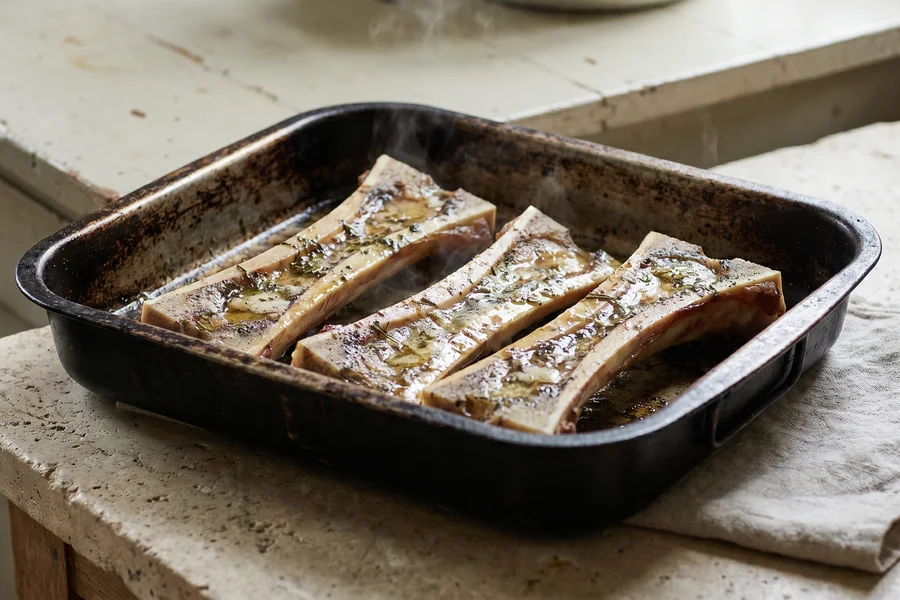
- Preheat your oven to 220°C (200°C fan / Gas 7).
- Place the marrow bones cut-side up in a roasting tin. No oil, no seasoning, nothing else.
- Roast for 15–20 minutes, until the marrow is soft and slightly wobbly and has started to pull away from the bone around the edges. It will look pale and slightly translucent in the centre — that's fine, provided it's soft all the way through.
- Remove from the oven and leave to cool completely. Don't rush this — marrow holds heat and can still be very hot in the centre when the outside feels fine.
- Once cooled, use a small teaspoon to scoop the marrow out of the bone in soft pieces.
You can roast a batch of bones, scoop all the marrow out, and freeze it in small portions — ice cube trays work well. Defrost what you need in the fridge overnight.
How to Serve Bone Marrow Baby-Led Weaning Style
If you're following a baby-led weaning approach, the easiest method is to serve the bone itself and let your baby suck and lick the marrow directly from the cavity — provided they are seated safely upright in their highchair and you are watching the whole time. The bone itself is not a choking hazard (it's far too large to fit in a baby's mouth), but always supervise.
Alternatively, scoop the marrow out and:
- Spread it thinly on a strip of toast — works well from 6 months once your baby is comfortable with soft finger foods
- Mash it into avocado — the fats complement each other and the texture is smooth and manageable
- Mix it into soft-cooked broccoli or sweet potato — the marrow adds richness and the colours are appealing
- Stir it into scrambled egg — one of the most nutrient-dense combinations you can offer
The taste is mild and slightly savoury — most babies take to it very readily, especially when paired with something they already enjoy.
How to Serve Bone Marrow to a Spoon-Fed Baby
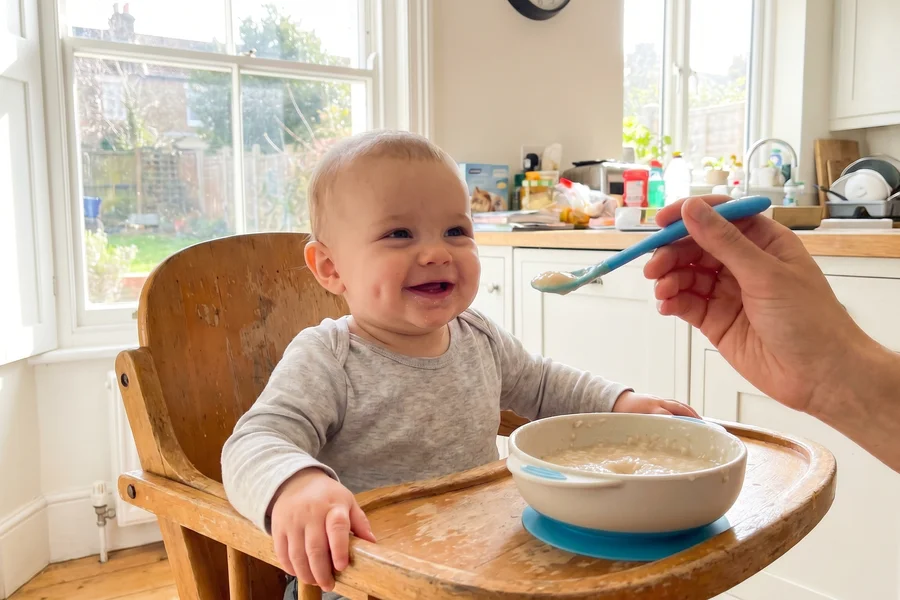
If you're spoon-feeding purees, bone marrow mixes beautifully into almost any vegetable or fruit puree. Because it's essentially pure fat, it blends smoothly without changing the texture significantly — it just adds richness.
Some combinations that worked well for us:
- Bone marrow + sweet potato puree — the most beginner-friendly combination. Naturally sweet, smooth, and the orange colour is visually inviting.
- Bone marrow + carrot and parsnip — earthy and comforting, good for autumn and winter weaning.
- Bone marrow + butternut squash — slightly sweet, very smooth when blended.
- Bone marrow stirred into porridge — sounds unusual, tastes fine. Adds fats to what is otherwise a carbohydrate-heavy meal.
Start with about half a teaspoon of marrow mixed into a portion of something your baby already accepts well. You don't need to make a big deal of it — just stir it in and serve as normal. Most babies don't notice at all.
Our Top Picks for Bone Marrow Weaning
You don't need much specialist kit to introduce bone marrow baby food — but a few things genuinely make it easier. A silicone bib is non-negotiable (marrow is fatty and will stain anything absorbent), and a highchair with a proper harness and easy-clean tray makes the whole process less chaotic.
How Often Can Babies Have Bone Marrow?
There's no official NHS guidance specifically on bone marrow frequency — it falls under the broader umbrella of meat and animal products, which the NHS recommends offering as part of a varied diet from 6 months.
In practice, two to three times a week is a sensible frequency. Because marrow is rich in fat, you don't need large amounts at each sitting — a teaspoon to a tablespoon of scooped marrow per meal is plenty, mixed into other foods or served directly.
The goal is always variety. Bone marrow for babies is one nutrient-dense addition among many — it works alongside iron-rich red meat, oily fish, eggs, legumes, dairy, a wide range of vegetables and fruits. No single food should dominate any baby's diet, and bone marrow is no exception.
What to Watch Out For
Bone marrow is a low-risk food overall, but a few things are worth keeping in mind:
- Source quality matters — as with any animal product, quality varies. Grass-fed beef marrow bones from a butcher or reputable online supplier are preferable to unlabelled supermarket options if you can access them. Grass-fed marrow bones are widely available online in the UK.
- No salt, ever — it bears repeating. Do not season the bones before roasting. The natural flavour of marrow is more than sufficient for a baby's palate.
- Avoid charring — burnt or very dark roasted marrow isn't ideal. Roast until just soft, not until brown and dried out.
- Store safely — if you're batch-cooking, scoop the marrow out, let it cool, then refrigerate for up to 3 days or freeze for up to 3 months. Label and date your containers.
- Don't give it when your baby is unwell — it's rich, and an already unsettled digestive system doesn't need the extra load. Stick to easily digested foods when they're under the weather.
Quick Tips Before You Start
A few things from our own experience that might save you some trial and error:
- Ask your butcher to halve the bones for you — they almost always will, and it makes cooking and scooping much easier than trying to deal with a whole long bone.
- Roast more than you think you need. Marrow shrinks slightly during cooking. Two bones per baby portion is about right — four or six at a time if you're batch-cooking.
- The smell during roasting is savoury and quite strong — open a window if you're sensitive to cooking smells.
- On particularly busy days, ready-made bone broth sachets stirred into purees or porridge are a reasonable shortcut — no added salt, no additives, just dissolve and add.
- If your baby refuses it initially, try mixing a smaller amount into a food they already love, or try again in a week. Some babies need 10–15 exposures to a new food before they accept it. Bone marrow is one of the more palatable ones for most, but nothing is universally loved.
Ready to explore more of what weaning can look like? Our complete baby feeding guide covers breastfeeding, formula, bottle feeding, first foods, allergen introduction and weaning equipment — everything in one place. And if you're looking at what to actually put those bottles and purees into, the glass baby bottles guide is worth a read too.