
About the Authors

We're Tom (33) and Sophie (31) — a Bath couple who launched BabyMade after becoming first-time parents to Freddie. Sophie's midwifery background and our shared obsession with finding genuinely good baby products turned into this blog. We write everything we wish we'd had when Freddie arrived.
Disclosure: This article contains affiliate links. If you buy through them we may earn a small commission at no extra cost to you. We only recommend products we genuinely rate.
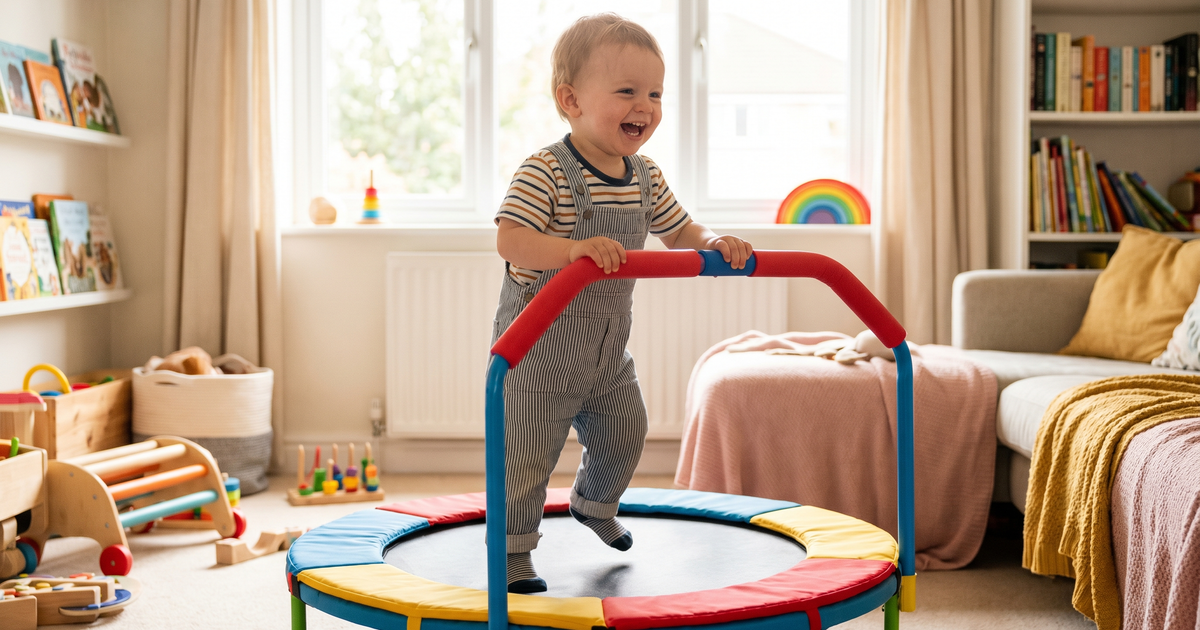
The moment Freddie started pulling himself up and bouncing on the sofa cushions, we knew a baby trampoline was next on the list. That phase — somewhere around 14 to 18 months — where toddlers discover that springing up and down is the most joyful thing in the world — is exactly what a good indoor toddler trampoline is designed for. The problem is the market is full of unsafe, flimsy options that look fine in photos and fall apart within weeks.
We bought one that lasted four sessions. The handlebar wobbled, the safety net detached from the frame, and the whole thing had a faint chemical smell that we were not comfortable with in an enclosed space. We sent it back. What we eventually found — and what we're writing up here — are the baby trampolines that are actually built for the job: stable, properly padded, with a handlebar your toddler can grip safely and a net that stays attached when they inevitably bounce sideways.
This guide covers everything you need to know before buying a baby trampoline in the UK — the right age to start, the safety features that genuinely matter, and the honest picks that are worth the money. If you're shopping for broader play equipment, our baby toys UK guide covers everything from birth to 12 months including sensory toys, play mats and activity centres.
What Age Can Babies Use a Baby Trampoline?
Despite the name, baby trampolines are not for babies in the traditional sense. Most indoor toddler trampolines specify a minimum age of 18 months to 3 years, depending on the model — and for good reason. A child needs to be able to stand independently, balance on their own, and grip a handlebar before bouncing is safe.
Before 18 months, most children simply don't have the balance, leg strength, or coordination to bounce safely even on a small trampoline. Some models designed for very young toddlers — those with a low bounce height, very wide base, and full enclosure net — may be suitable from around 12 months if your child is walking confidently. But always read the manufacturer's age and weight guidance on the specific model you're considering. These limits are not just legal cover — they reflect genuine developmental readiness.
The upper limit matters too. Most baby and toddler trampolines have a weight limit of around 50–70kg, but they're designed for the developmental stage of a young toddler, not an older child or an adult bouncing alongside. Once your child outgrows the weight or age limit, it's time to move to a full-size outdoor model.
Indoor vs Outdoor Baby Trampolines — Which Is Better?
Most baby trampolines designed for young toddlers are built for indoor use — they're compact (typically 3ft or 4ft in diameter), light enough to move from room to room, and have rubber feet to grip hard floors. They're also usually year-round: it doesn't matter whether it's raining in Bath in February, Freddie can still get his bouncing fix in the living room.
Outdoor toddler trampolines exist too — slightly larger, more weather-resistant, and often installed directly on grass. They're a good option if you have outdoor space and want something the child can grow into. But for babies and young toddlers specifically, we'd lean toward an indoor mini trampoline for one important reason: supervision. It's much easier to supervise a toddler on an indoor trampoline you can see from the kitchen than one at the bottom of the garden.
Indoor mini trampoline: Best for toddlers 18 months to 3 years. Compact, easy to move, suitable for year-round use regardless of weather. Look for rubber non-slip feet for hard floors.
Outdoor toddler trampoline: Better for slightly older children (3+) who have more established balance. Needs to be pegged into the ground or weighted. Requires weather protection and a fixed spot in the garden.
What to Look For in a Baby Trampoline
The quality gap between a safe toddler trampoline and an unsafe one is significant. Here's what actually matters:
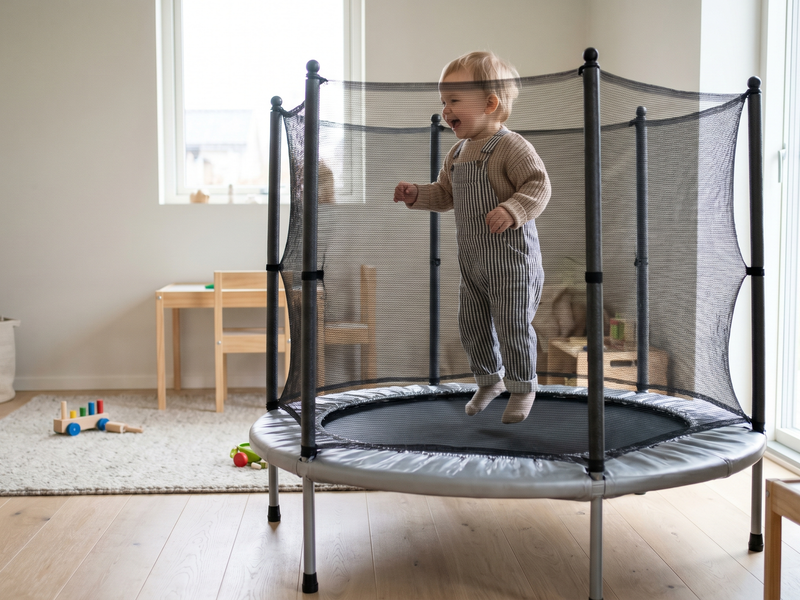
Safety enclosure net. For children under 3, this is non-negotiable. The net should attach securely to the frame — not just clip on — and should be tall enough that a bouncing toddler can't easily tumble over the top. Check that the zipped or velcro opening is secure and that the attachment points are solid, not just looped thread.
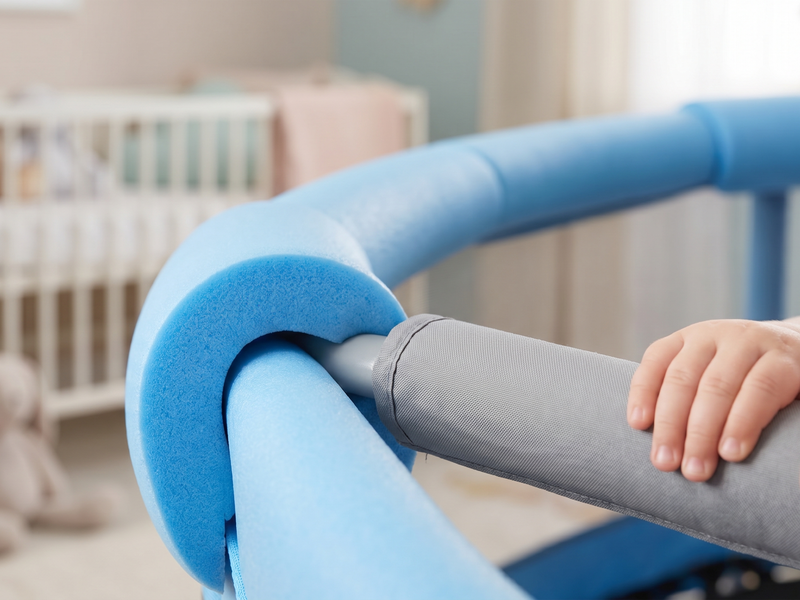
Padded handlebar. A handlebar gives your toddler something to grip for balance and builds confidence on the trampoline. It should be at a comfortable height for a standing toddler — roughly waist to chest height — and the padding should be firm enough to actually protect against impact, not just decorative foam.
Padded frame and springs. The spring system (or bungee cord system in some models) should be fully covered. Exposed springs are a serious pinch hazard for small fingers. Check the frame padding too — it should wrap the full circumference of the trampoline and stay in place when bounced on, not slide around.
Weight limit and age range. Check both. A trampoline with a 50kg weight limit is appropriate for a young toddler alone — not for a parent bouncing alongside them. If you want to demonstrate bouncing, stand beside the trampoline rather than on it.
Non-slip feet. Essential for hard floors. Rubber feet or suction cups stop the frame walking across the room mid-bounce, which is both annoying and a trip hazard for any adults nearby.
Assembly and portability. A baby trampoline that takes 90 minutes to assemble and lives permanently in one spot is a different product to one that can be folded flat and moved to another room or stored in a cupboard. Think about how you'll actually use it before buying.
Our Top Baby Trampoline Picks
These are the picks that passed our checklist: proper safety enclosure, solid handlebar, padded springs, and stable enough that a determined 2-year-old throwing their whole weight sideways doesn't tip the thing over. They cover the main price points and use cases most UK parents are shopping for.
If you're looking for other active play options alongside a baby trampoline, our baby ball pit guide covers the best soft-sided and inflatable ball pit options for the same age range — they work well together for a proper active play corner. And when you need a quieter toy to wind down after all that bouncing, our beanie baby gifts guide is worth a look — a Ty plush is the kind of soft toy toddlers drag everywhere.
Best Mini Trampolines for Toddlers — Budget Options
Budget baby trampolines start from around £30–£40. At that price point, you can find a basic mini toddler trampoline with a handlebar and minimal enclosure — suitable for a 2-to-3-year-old who is steady on their feet. What you typically sacrifice at the budget end is enclosure quality (clips rather than proper attachment points), handlebar height adjustment, and overall build stability.
For under-2s, we'd stretch to the mid-range (£50–£80) because the enclosure quality difference is meaningful at this age. For a confident 2.5-to-3-year-old who bounces in controlled bursts, a well-reviewed budget option is a reasonable choice — just check the reviews specifically for net attachment and handlebar wobble before buying.
Baby Trampoline Safety Tips
Trampolines — even small indoor ones designed specifically for toddlers — require active supervision and a few simple rules. The Royal Society for the Prevention of Accidents (RoSPA) recommends one person bouncing at a time, which is even more important for young toddlers who can't yet predict or respond to another person's movements.
Here are the practical safety rules we follow with Freddie:
- One at a time, always. Never let two toddlers bounce simultaneously, even if the trampoline is large enough to hold them. Collision risk is significant.
- Always supervise. A toddler should never be left on a baby trampoline unsupervised, even for a moment. Falls happen fast.
- Check the enclosure before every use. A loose net attachment or unclipped opening can fail mid-bounce. Take 10 seconds to check it before each session.
- Keep the area clear. Move furniture away from the trampoline. Falls off the side — even with a net — can happen if the net attachment fails, and landing on furniture is much worse than landing on the floor.
- Short sessions for young toddlers. 5–10 minutes at a time with rest breaks. Bouncing is surprisingly physically demanding for small bodies.
- No shoes. Socks or bare feet only. Shoes add grip in unpredictable ways and hard soles can damage the mat surface over time.
- Follow the weight limit strictly. This is the one parents most frequently ignore. If the model specifies a 50kg limit, that limit applies to the total weight on the trampoline — which includes a parent perching on the edge.
For broader advice on creating a safe play environment at home — including safe sleep setup, appropriate toys by age, and floor space planning — our baby sleep guide and full baby toys guide cover everything from the newborn stage through to the busy toddler years.