

About the Authors

We're Tom (33) and Sophie (31) — a Bath couple who launched BabyMade after becoming first-time parents to Freddie. Sophie's midwifery background and our shared obsession with finding genuinely good baby products turned into this blog. We write everything we wish we'd had when Freddie arrived.
Disclosure: This article contains affiliate links. If you buy through them we may earn a small commission at no extra cost to you. We only recommend products we genuinely rate.
We bought our Tula when Freddie was about six weeks old, after three weeks of attempting to use a stretchy wrap and spending most of those three weeks either too hot, getting it tangled round ourselves, or redoing it because we weren't confident he was in correctly. A friend with a four-month-old showed up wearing a Tula Free-to-Grow, baby fast asleep, one hand free, looking improbably calm. We ordered one that evening.
Eight months later, the Tula baby carrier is still in weekly rotation. It has done school runs, supermarket trips, a weekend in Edinburgh and approximately four hundred walks round our neighbourhood at 3am because Freddie will sleep in the carrier when he refuses to sleep anywhere else. It is, without question, one of the best things we bought in the first year.
This is the review we wish we'd had before we bought it — what makes it good, what the actual differences between models are, how it compares to the alternatives, and who it is and isn't right for. For the broader picture on carriers, slings and prams, our baby carriers UK guide covers the full range of options from stretchy wraps through to structured carriers and prams.
What Is the Tula Baby Carrier?
Tula is an American brand that has built a substantial following in the UK babywearing community over the past decade. They make soft structured carriers (SSCs) — the type with a structured panel and buckles, as opposed to ring slings or stretchy wraps. Their carriers are known for beautiful printed fabrics, genuinely good build quality, and a very active second-hand market that holds its value well.
The main Tula line consists of several models: the standard Tula (which requires a separate insert for newborns), the Free-to-Grow (which adjusts to fit from birth), the Explore (which adds front-facing-out as a carry position), and the Lite (a lighter mesh version for warmer weather). There are also ring slings and toddler-sized carriers in the range.
All Tula carriers share the same core design principle: a structured seat panel that supports the baby's legs in the ergonomic M-position (knees higher than bottom, thighs spread around the carrier panel), padded straps and waistband for the wearer, and a snap-and-buckle system that is straightforward to get on once you have learned it. The International Hip Dysplasia Institute has certified Tula carriers as hip-healthy products.
Tula Free-to-Grow vs Standard Tula — Which Should You Buy?
This is the question we get asked most. The short answer: if your baby is a newborn or you are buying before birth, get the Tula Free-to-Grow. Here is why.
The standard Tula has a fixed seat width that works well for babies roughly from 5kg upwards. Younger and smaller newborns do not fill the panel correctly, which means their legs dangle rather than sitting in the M-position. Tula sells a separate infant insert to fix this, but it is an extra cost (typically £30–£40) and an extra thing to manage. Once your baby grows into the standard Tula's seat, the insert becomes redundant and gets consigned to the drawer where all the things you no longer need live.
The Free-to-Grow solves this by building the adjustment into the carrier itself. The seat panel has a narrower position (snapped inwards) for small newborns and widens as the baby grows. You get the same carrier for the whole journey from birth through toddlerhood, with no insert required and no extra purchase.
The price difference between the two is modest — typically £20–£30 in favour of the standard Tula. When you factor in the cost of the insert you would otherwise need, the Free-to-Grow usually comes out ahead on value. The only reason to choose the standard over the Free-to-Grow is if your baby is already several months old and past the newborn stage when you buy.
How Does the Tula Baby Carrier Fit?

Getting the fit right matters for both the baby's comfort and yours. The good news: Tula carriers are relatively forgiving to adjust, and the instructions are clear enough that most parents get a workable fit within a few attempts.
For the baby: the seat panel should support the thighs all the way from the back of the knee to the bum, with the knees bent and higher than the bottom (the M-position). The carrier should come up high enough on the baby's back to be supportive, and the baby's chin should be off the chest with the airway clear. You should always be able to see and kiss the top of your baby's head.
For the wearer: the waistband sits on or just above the hips — not at the waist. This is counterintuitive for most people but essential for comfortable weight distribution. The shoulder straps should be adjusted so the carrier is pulled in close against your body with no gap between you and the baby. Tula's padded straps are genuinely comfortable for extended carries; on longer walks we found it significantly better than any stretchy wrap we tried.
One thing to note: Tula carriers are sized for standard adult torsos. If you are particularly petite or have a very long torso, you may find the fit slightly tricky — in which case trying one at a sling library before buying is worth doing. The UK has a good network of sling libraries where you can borrow and test carriers before committing.
Is the Tula Baby Carrier Good for Newborns?
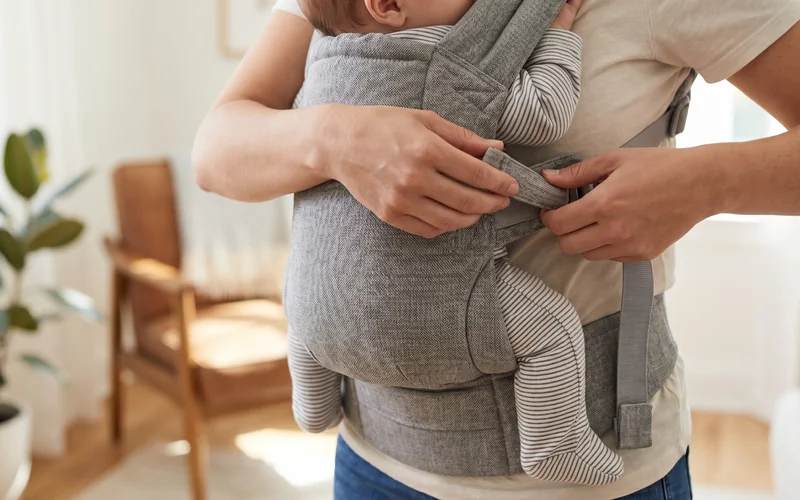
With the Free-to-Grow: yes, genuinely. We started using ours at six weeks and it was transformative. Freddie would fall asleep within about ten minutes of going in, which at six weeks felt like some kind of miracle. The narrowed seat setting on the Free-to-Grow holds a small baby securely, the head support panel gives enough structure to keep the head from flopping forward, and the whole setup is intuitive enough that you can get it on with one hand after a week or two of practice.
With the standard Tula plus an insert: workable, but more fiddly. The insert adds bulk and warmth, and getting the combination of insert plus carrier correctly adjusted takes longer. Fine if you already own a standard Tula and want to use it from birth, but not the starting point we would recommend.
The babywearing safety guidelines — TICKS (Tight, In view at all times, Close enough to kiss, Keeps chin off chest, Supported back) — apply to all carriers including the Tula. Worth familiarising yourself with these before using any carrier for the first time.
Carrying Positions the Tula Supports
The standard Tula and Free-to-Grow support two main carry positions:
- Front carry, facing in — the standard position. Baby faces your chest, knees in M-position. Works from newborn through to the weight limit (around 20kg). This is what you will use most of the time, especially in the early months.
- Back carry — baby goes on your back, same M-position. Brilliant once your baby has good head and trunk control (typically from around 6 months). Gives you full use of both hands and is much more comfortable for longer periods. The Tula's padded waistband makes back carrying genuinely comfortable even on extended hikes.
Front-facing-out is not supported on the standard Tula or Free-to-Grow — more on that in the comparison section. If front-facing-out is something you specifically want, you need the Tula Explore, which adds a structured outward-facing position.
Tula Baby Carrier Comfort — An Honest Assessment
For the baby: very comfortable, in our experience and in the consistent reports from the babywearing community. Freddie has always settled quickly in the Tula, which is a pretty reliable signal. The structured seat, the padded back panel and the head support all contribute to this. Tula carriers are also consistently rated well on the second-hand market, where condition is a proxy for how often they were actually used — heavily used carriers show their wear, and Tula carriers tend to still look excellent after years of use, which says something about the construction.
For the wearer: genuinely good for an SSC in this price range. The padded waistband distributes weight well across the hips and lower back, and the structured shoulder straps reduce the fatigue you get from narrower strap carriers. I (Tom) have a slightly bad lower back and found the Tula noticeably more comfortable than our previous stretchy wrap after about 45 minutes. Sophie found the same on longer carries. That said, no carrier eliminates all fatigue on a two-hour back carry — don't expect miracles.
Tula Fabrics and Prints — Does It Matter?
Tula is well known for its fabric range — they produce carriers in hundreds of prints and colourways, from classic solids to elaborate collaborations with artists and designers. This is partly what drives the brand's following and partly what drives the second-hand market. Certain prints are genuinely collectible and hold their value remarkably well.
From a practical standpoint: all Tula carriers use woven cotton fabric for the main panel, which is breathable, soft and durable. The hardware — buckles, rings, webbing — is consistent across the range. The print you choose doesn't affect the carrier's function, only its aesthetics and resale value. If you are buying primarily as a practical tool rather than a collector's item, choose whichever print you like and don't overthink it.
If you are likely to want to sell it on (which is absolutely worth planning for — Tula carriers sell quickly and hold value well on Facebook Marketplace and Vinted), the more popular prints from standard collections retain value better than unusual or limited edition runs, which can be hit-or-miss depending on demand.
How Does the Tula Compare to Other UK Carriers?
The Tula sits in a competitive market. Here is how it compares to the main alternatives you will encounter in the UK:
- Ergobaby Omni 360 — the most direct competitor. Supports front-facing-out (Tula standard and Free-to-Grow don't). The Omni 360 has a slightly more clinical, functional aesthetic compared to Tula's fabric-forward approach. Comfort is broadly comparable for most wearers. If front-facing-out matters to you, the Ergobaby wins this comparison.
- BabyBjörn One Air — easier to put on and take off solo, especially the lumbar clip version. Very simple design, fewer adjustments to get right. The tradeoff is that it is less comfortable for longer carries as the weight distribution isn't quite as good as the Tula. Better for quick carries; Tula better for extended ones.
- Lillebaby Complete — excellent lumbar support and six carry positions. Less well-known in the UK than the US but worth considering. Good value.
- Ring slings and wraps — more versatile for very young babies, lower learning curve for newborn positioning (with a stretchy wrap), but less comfortable for extended back carries with an older baby. Different tools for different stages.
Our overall view: the Tula is among the best soft structured carriers available in the UK for parents who want something comfortable for all-day use and plan to babywear from newborn to toddler. It is not the most affordable option and it doesn't do front-facing-out (in standard models), but on durability, comfort and resale value, it consistently outperforms the competition. For the full picture on what to consider when choosing between all these options, our baby carriers guide breaks down every carrier type in detail.
Is the Tula Baby Carrier Worth the Price in the UK?
The Tula Free-to-Grow typically retails at around £130–£160 new in the UK depending on the print. The standard Tula is £10–£30 cheaper. These are not impulse-buy prices — but they need to be considered against what you are actually getting.
A carrier that is used daily for even six months is being used around 180 times. At £150, that works out to under £1 per use. For a product that lets you have two free hands, keeps your baby content, actively supports their hip and spine development, and — not insignificantly — gets them to sleep when they would otherwise be awake and unhappy, under a pound per use is very good value.
The second-hand market is also relevant. Tula carriers in good condition regularly sell for 60–75% of their original price on Facebook Marketplace, Vinted and babywearing groups. A £150 carrier that sells for £100 when you are done with it has cost you £50 for a year or more of use. That changes the maths significantly.
If the new price is genuinely stretching, buying second-hand is a completely sensible option — just make sure you check for signs of wear on the buckle webbing and request photos of the seat panel stitching, as these are the areas that take the most stress.
A Tula also makes an excellent baby gift for a new parent who babywears — see our personalised baby gifts guide for ideas to wrap alongside it, or our baby blankets guide for what to layer over the carrier in colder months.
How to Clean and Care for Your Tula Carrier
Tula carriers are machine washable, which is a practical necessity given what they get exposed to — milk, dribble, sunscreen, the occasional nappy incident. The standard care instructions:
- Machine wash at 30°C on a gentle cycle, inside a mesh laundry bag to protect the buckles and prevent the webbing from catching
- Air dry only — tumble drying can shrink the fabric and damage the buckle webbing. Hang flat or over a rail to maintain the shape of the seat panel
- No fabric softener — it can reduce the grip of the woven fabric and build up on the padding over time
- Spot clean between washes — a damp cloth and mild soap on the shoulder straps handles most of the daily grime without a full wash
The buckles and webbing should be inspected regularly for any signs of fraying or cracking. If you notice any damage to the load-bearing webbing or if a buckle shows cracks, contact Tula directly — they have a good reputation for customer service and take safety issues seriously.
Where to Buy Tula Baby Carrier in the UK
Tula has grown its UK distribution significantly over the past few years. You can now find them at:
- Tula's own website — the widest selection of prints and models. Ships to the UK. Worth checking for seasonal sales.
- Amazon UK — reliable for standard models and popular prints. Search Tula baby carrier on Amazon UK to compare current prices and available models.
- Independent baby retailers — many independent baby shops stock Tula, particularly those with babywearing expertise. Worth supporting if you have one locally, as staff can often help with fit and adjustment.
- Sling libraries — not a retailer, but worth mentioning. You can borrow a Tula from a sling library for a small fee (typically £10–£20 for a fortnight) to try before you commit to buying. This is genuinely the best way to know if a specific carrier works for your body type and your baby.
- Second-hand — Facebook Marketplace, Vinted and dedicated babywearing selling groups. Good condition Tulas sell quickly and authenticity is generally reliable in the babywearing community.
If you are buying for the first time and unsure which model to get, phoning a babywearing-specialist retailer is worth doing — they can ask about your baby's size, your body type and your typical use case and give personalised advice. That is a service you won't get from a large online retailer.
Worth pairing with a good pram for longer outings — our Baby Jogger City Mini review covers what we think is the best compact pram for UK city life, which pairs well with a Tula for shorter trips.
Our Verdict After Using It Every Day
The Tula baby carrier is, without question, one of the products we would put on any new parent shortlist. It does what it claims — comfortable for extended carries, ergonomically correct, well-made, and it holds its value. The Free-to-Grow is the version to buy if you are starting from newborn; it removes the insert cost and faff and gives you a single carrier for the whole journey.
It is not cheap. But in a category where you genuinely get what you pay for, the Tula earns its price. The fact that you can sell it for 60–75% of what you paid when you no longer need it makes the net cost reasonable. And the fact that eight-month-old Freddie still settles in it in under ten minutes — when he is refusing his cot, his pram, his bouncer and approximately six different positions we have tried — means we are keeping ours for a while yet.
For everything you need to know about choosing between carrier types, understanding ergonomic positions and deciding what works for different stages, see our full baby carriers & prams guide — it covers the whole picture from newborn wraps through to frame carriers for toddlers.