
About the Authors

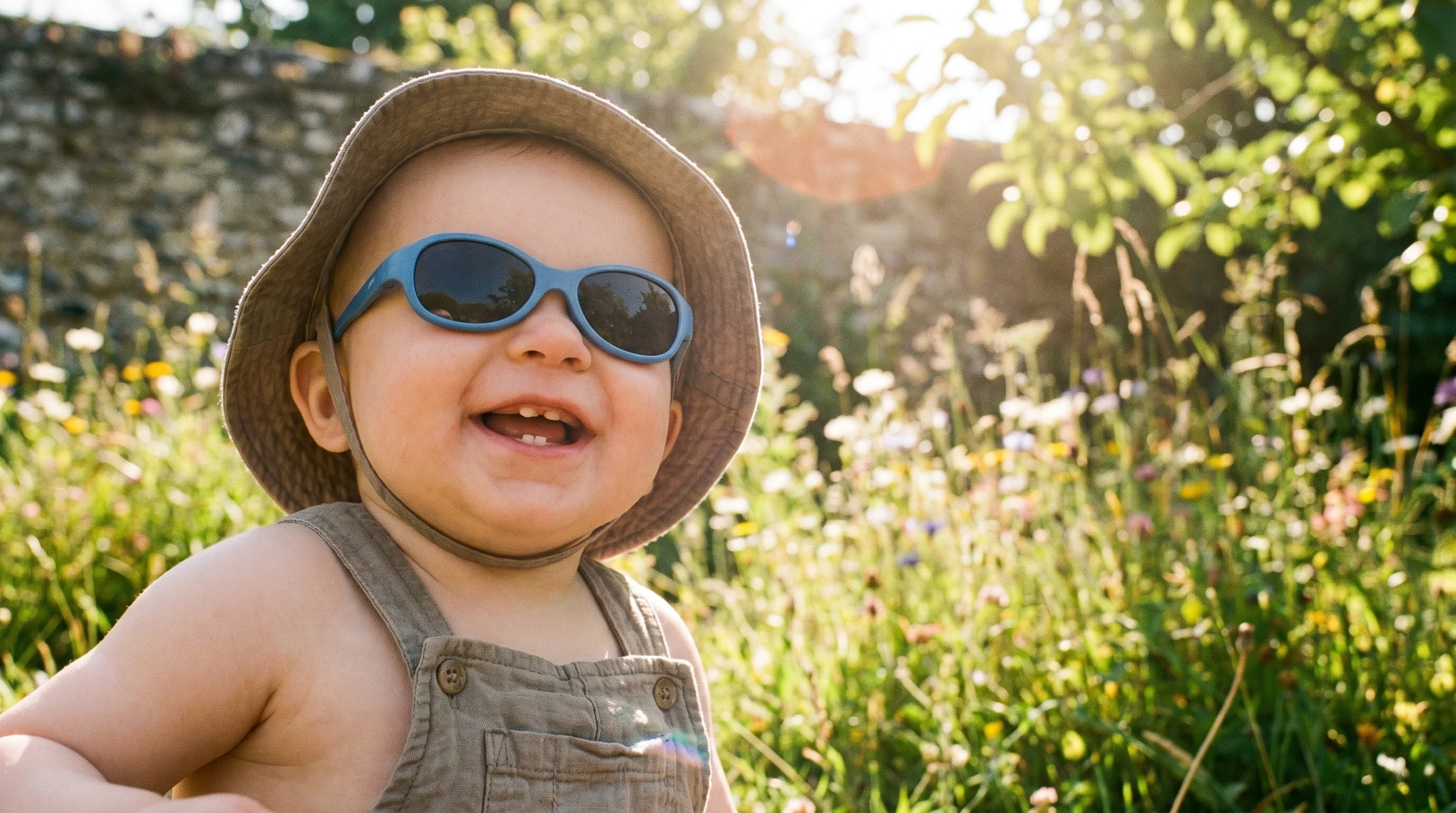
We're Tom (33) and Sophie (31) — a Bath couple who launched BabyMade after becoming first-time parents to Freddie. Sophie's midwifery background and our shared obsession with finding genuinely good baby products turned into this blog. We write everything we wish we'd had when Freddie arrived.
Some links in this article are affiliate links. If you buy through them we earn a small commission at no extra cost to you. We only recommend products we genuinely rate.
It was our baby's first proper summer — she was about five months old, we were at a family barbecue, and everyone kept saying "aww, she's squinting, she needs sunglasses." I'd bought a pair impulsively at a market stall a few weeks earlier — cute little round things, no certification markings, probably £3 — and I honestly had no idea whether they were actually doing anything useful for her eyes or just looked good for photos.
That afternoon I went down a rabbit hole. Baby sunglasses, it turns out, are one of those things where there's a big difference between something that looks the part and something that actually works. UV400, CE marks, polarised lenses, flexible frames — it all matters more than I'd assumed.
This is the guide I wish I'd had. Everything you need to know about baby sunglasses in the UK — what the certifications mean, when babies can start wearing them, how to keep them on (the eternal challenge), and which ones are actually worth buying. Part of our wider baby clothing guide — because yes, sunglasses count as an accessory.
Quick answer: Look for UV400 lenses and a CE or UKCA mark. Flexible rubber frames with an elastic strap are far more practical than rigid frames. From around 3–6 months is the sweet spot to start — though you can begin earlier with wrap-around styles.
Do Babies Actually Need Sunglasses?
This is the question I had, and the honest answer is: yes, in sunny conditions, they do — and it's not just about the photos (though those are admittedly brilliant).
Babies' eyes are still developing, and the lens inside a young baby's eye is significantly clearer than an adult's. That means more UV radiation passes through to the retina. Cancer Research UK notes that cumulative UV exposure during childhood is a key risk factor for eye conditions later in life, including cataracts and macular degeneration. Starting good sun protection habits early matters.
In the UK, this doesn't mean your baby needs baby sunglasses on every grey February morning — that would be overkill. But during summer months, on holiday, near water or snow (which reflects UV strongly), or any time you'd reach for your own sunglasses, theirs should come out too.
The NHS sun safety guidance recommends keeping babies under 6 months out of direct sunlight where possible — but for those moments when that's not practical, proper UV400 baby sunglasses are a sensible layer of protection alongside a wide-brimmed hat and appropriate clothing.
What Age Can Babies Start Wearing Sunglasses?
Technically, from birth — there are newborn-specific styles designed for tiny faces. But realistically, it depends on what you're working with.
0–3 months
At this age, the easiest protection is a pram hood or carrier canopy, a wide-brimmed hat, or a pram sun shade. Wrap-around-style baby sunglasses can work if your baby tolerates them, but most parents find this age group pulls them off immediately or can't maintain the head position needed for standard frames to sit correctly.
3–6 months
This is where it starts to become genuinely practical. Baby can hold their head more steadily, they're more alert and interested in the world, and you can introduce sunglasses as a normal part of going outside. Flexible-frame baby sunglasses with an elastic strap work well from this age — they sit securely without depending on the baby keeping still.
6–12 months
The challenge intensifies, because now they have the fine motor skills to yank them off with purpose. An elastic strap is non-negotiable. The good news is that babies introduced to sunglasses early tend to tolerate them better — it's just part of what happens when you go outside, like going in the buggy or putting a hat on.
1–3 years
Toddlers are a special kind of chaos, but they're also old enough to understand "sunglasses on for sunny days" if you're consistent. Toddler-specific styles are slightly larger, still flexible, and often have more fun design options that children are more inclined to actually wear willingly.
UV400, CE Mark and What to Look For in Baby Sunglasses
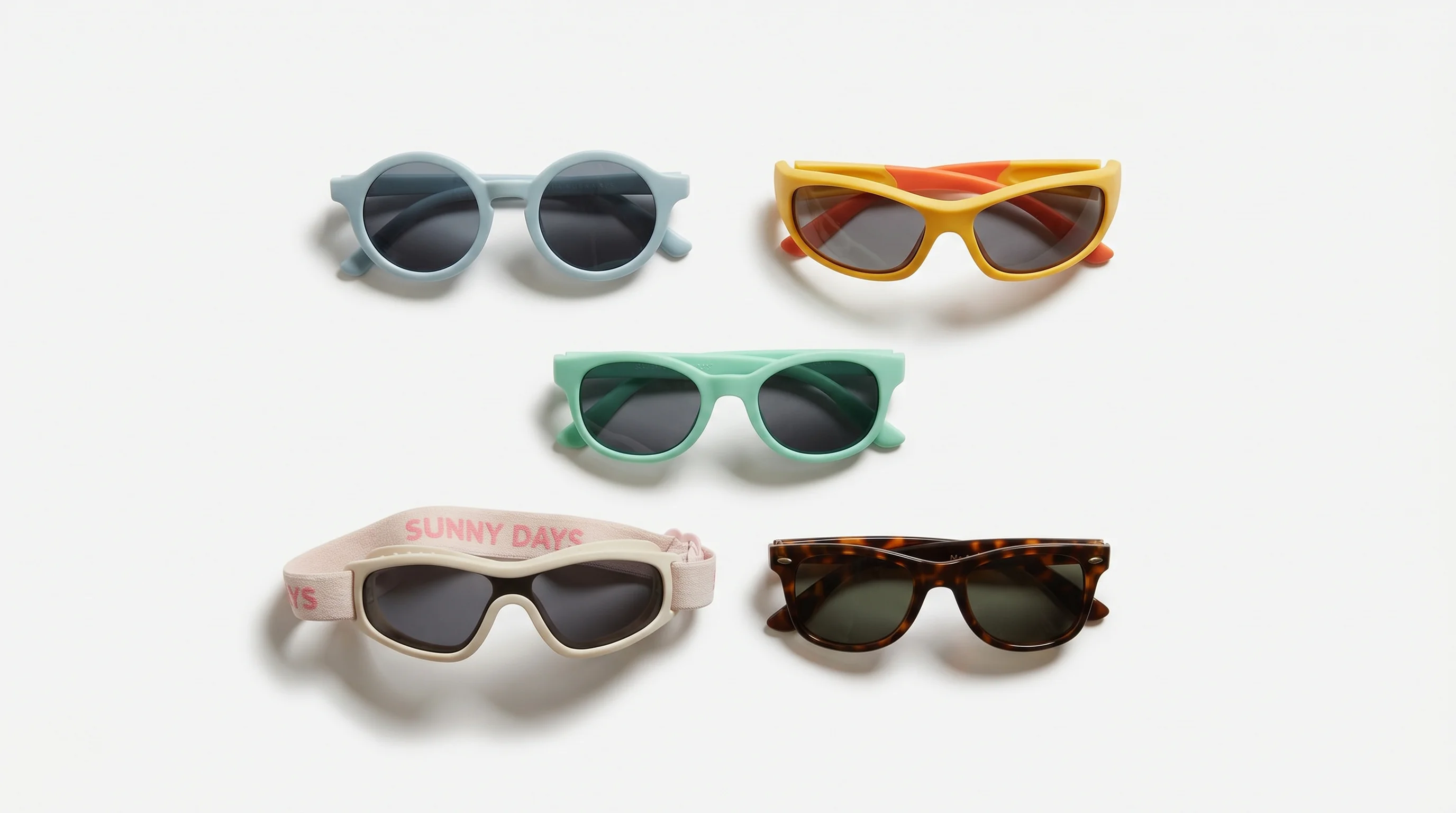
This is the bit where most parents get confused, because the packaging on cheap sunglasses can be deliberately unclear. Here's what actually matters:
UV400 — the lens standard
UV400 means the lenses block wavelengths up to 400 nanometres — that's 99–100% of both UVA and UVB rays. This is the standard you want. "UV protection" without a specific rating can mean almost anything. "UV380" blocks slightly less. UV400 is the gold standard.
CE mark (or UKCA mark)
The CE mark (or post-Brexit UKCA mark) is a regulatory certification confirming the product meets EU/UK safety standards, including the optical safety standard EN ISO 12312-1. This is different from UV400 — it covers the physical construction of the sunglasses: lens quality, impact resistance, and whether the product is safe for a baby to wear. Look for both UV400 and CE/UKCA on any pair you buy.
Frame material
For babies, flexible rubber or silicone frames are far better than rigid plastic. Babies grab, bend and sit on their sunglasses constantly. A flexible frame survives; a rigid one cracks. Flexible frames also mean no sharp edges if a baby falls wearing them, which matters more than you'd think.
How they stay on
Standard arm-over-ear frames work fine for older children who sit still. For babies and toddlers, an adjustable elastic strap around the back of the head is the only thing that reliably keeps sunglasses in place. Some styles have removable straps; others have them built in. Either works — as long as the strap is there.
Baby Sunglasses by Age: Which Style for Which Stage
Best baby sunglasses for 0–6 months
At this age you want a wrap-around or band-style design that sits securely against the face without depending on standard temple arms. These styles work even when babies don't have their head at the exact right angle — they conform to the face rather than balancing on it. Look for the softest possible silicone frame and a very gentle elastic. The lenses don't need to be large — baby's field of vision at this age is still quite central.
Best baby sunglasses for 6–12 months
From six months you can move to more conventional-looking baby sunglasses — round frames, aviator styles — as long as they have an elastic strap. Round frames with a good strap are the most popular style in this age range and the easiest to find. This is also when it becomes worth spending a little more, because you'll actually be using them regularly and the difference in quality is noticeable.
Best toddler sunglasses (1–3 years)
Toddler sunglasses are sized slightly larger and tend to have more robust frames — because toddlers are significantly rougher with everything than babies. Wraparound styles offer better UV coverage (no light sneaking in from the sides) and stay on better during the inevitable running-and-falling-over. This is also the age where buying a two-pack makes strong financial sense.
Baby Sunglasses That Actually Stay On
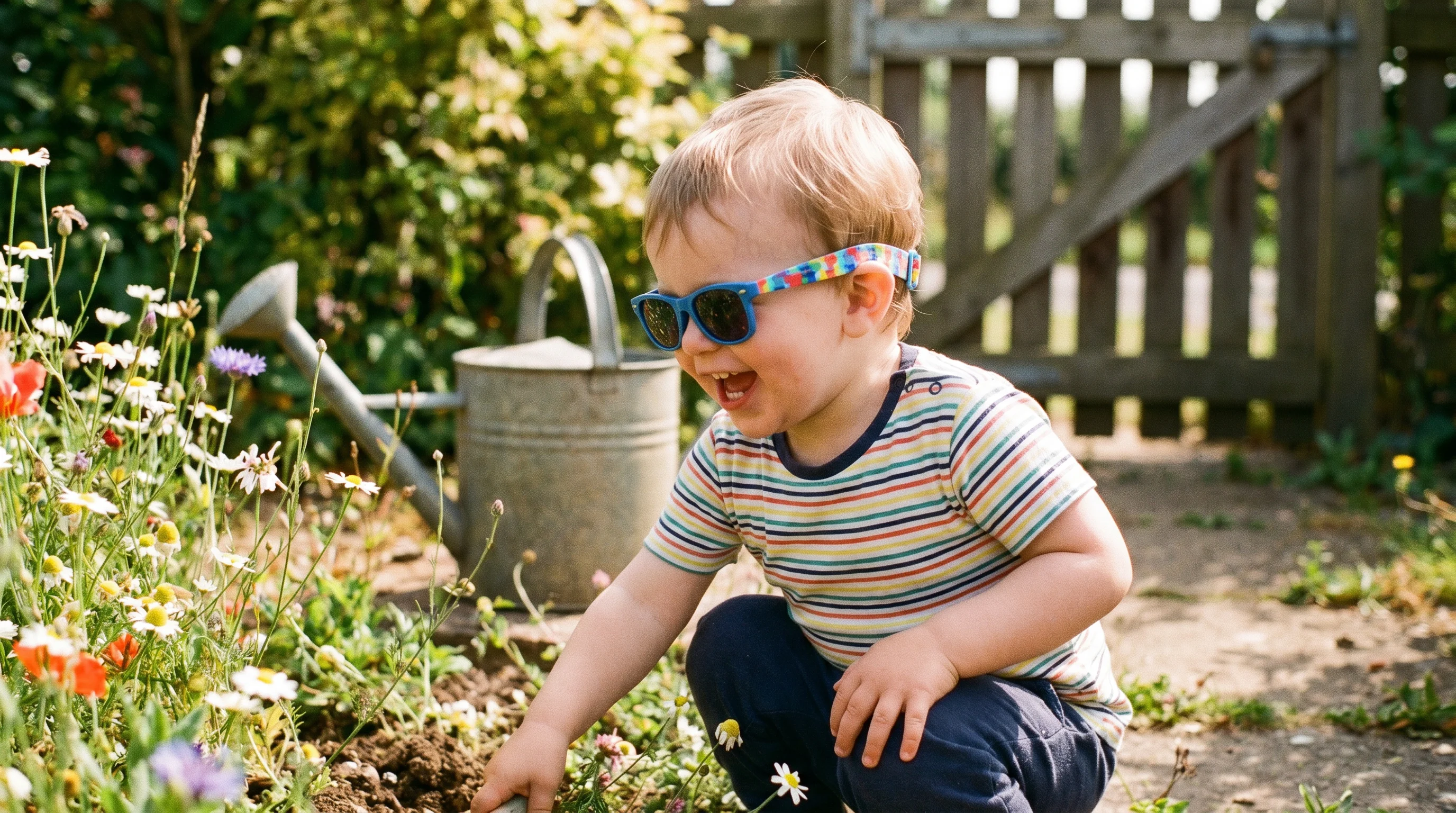
Every parent of a baby who's tried sunglasses has the same story: you put them on, baby looks adorable for about four seconds, then they grab them and launch them in the direction of the nearest puddle. Here's what actually helps:
- Elastic strap, always. Not optional for this age group. The strap goes around the back of the head and keeps the frames in place even when baby grabs at them. Adjustable is better than fixed — a too-tight strap is uncomfortable and they'll fight it more.
- Introduce them at home first. Let baby wear sunglasses inside for short periods before you need them outside. They become familiar rather than strange and new when you're standing in a car park trying to sort them out.
- Put them on before going out, not after. Once baby is distracted by being outdoors, anything new on their face gets removed immediately. Put sunglasses on as part of the "getting ready to go out" routine, like shoes.
- Be consistent. If sunglasses come out every single time it's sunny, they become normal. If you only try occasionally, they'll always feel like a novelty worth removing.
- Distraction helps. A snack, a toy, or just setting off immediately rather than standing still tends to make the difference between sunglasses staying on and coming off in under a minute.
Budget Baby Sunglasses vs. Worth Spending More
You can spend anywhere from £3 to £30+ on baby sunglasses. Here's the honest breakdown:
When budget is fine
If you're buying a novelty pair for photos, or a spare pair to live in the bottom of the change bag, a budget pair works. The key — and this is non-negotiable — is still checking for UV400 and CE/UKCA marking. A cheap pair with proper certification is better than an expensive-looking pair without it. A two-pack at around £8–£12 is a perfectly sensible choice for babies who will definitely lose or destroy at least one pair.
When spending more is worth it
If your baby is actually going to wear sunglasses regularly — holidays, summer weekends, outdoor nursery — spending more gets you better lens quality, a more durable flexible frame, and usually a better strap system. The Babiators brand in particular has a strong track record: virtually indestructible frames, excellent UV certification, and a Lost & Found guarantee. For a child who actually wears them every sunny day, a better pair pays for itself quickly.
What to avoid completely
Market stalls and very cheap online sellers selling sunglasses with no markings at all. No CE mark, no UV rating, no product standard listed anywhere — these are fashion accessories, not eye protection, regardless of what the packaging says. They look the same but provide essentially no UV protection. For an adult it's not ideal; for a baby whose eyes are still developing, it's not worth the risk.
Caring for Baby Sunglasses
Baby sunglasses take a beating. They go in mouths, get dropped on pavements, get sat on in the car, and somehow end up at the bottom of the change bag covered in biscuit. A few things that make them last longer:
- A hard case. Soft pouches are better than nothing; a hard case is actually protective. The scratching you get from loose sunglasses at the bottom of a bag ruins lenses within weeks.
- A microfibre cloth. Wiping lenses with a tissue or your sleeve scratches them faster than you'd expect. A microfibre cloth costs almost nothing and keeps lenses clearer for longer.
- Rinse rather than scrub. Baby sunglasses often get sticky from food and sunscreen. A quick rinse under cool water is gentler on lens coatings than scrubbing with a cloth.
- Replace when the lenses are scratched. Scratched lenses aren't just blurry — they can scatter light in ways that are actually harder on the eyes than no lenses at all. If they're badly scratched, it's time for a new pair.
For the rest of your baby's wardrobe — from sleepsuits to first shoes to occasion wear — our full baby clothing guide covers everything you need from newborn to toddler. And if you're looking for something that doubles as a lovely gift, a pair of novelty baby sunglasses alongside a personalised baby gift makes a genuinely brilliant baby shower or birthday present.
Sun safety reminder: Baby sunglasses are one part of sun protection — not the whole picture. The NHS recommends keeping babies under 6 months out of direct sun, using SPF 50+ sunscreen on exposed skin from 6 months, and covering up with a wide-brimmed hat and appropriate clothing. Sunglasses work alongside these measures, not instead of them.