
About the Authors
We're Tom (33) and Sophie (31) — a Bath couple who launched BabyMade after becoming first-time parents to Freddie. Sophie's midwifery background and our shared obsession with finding genuinely good baby products turned into this blog. We write everything we wish we'd had when Freddie arrived.
Disclosure: This article contains affiliate links. If you buy through them we may earn a small commission at no extra cost to you. We only recommend products we genuinely rate.
Freddie's first rattle was a soft fabric one that came in a welcome-home gift set. He stared at it blankly for about four weeks, then one morning grabbed it, shook it, heard the jingle, and looked at his own hand like he'd just discovered electricity. It's one of those early moments that sounds completely mundane when you describe it and is completely astonishing when you witness it.
A baby rattle is the first toy most babies can actually interact with. Not look at, not be entertained by — actually interact with, where their own actions produce a result. That's a genuinely big developmental step, and it happens sometime between 3 and 5 months for most babies. Choosing the right rattle for that stage — and the stages before it — is worth a bit of thought.
This guide covers everything you need to know about baby rattles UK parents are actually buying in 2026: the different types, which work at which age, what to look for, what to avoid, and the picks we'd genuinely recommend. For the full picture on first toys, see our baby toys UK guide.
Quick tip: Don't buy a rattle that's too loud for the first weeks. Newborns' hearing is sensitive — a gentle jingle is far more appropriate than a loud clatter. If it sounds too loud to you, it definitely sounds too loud to them.
When Do Babies Start Using a Baby Rattle?
Babies can be introduced to a rattle from birth — but what "using" a rattle looks like changes dramatically across the first year.
0–3 months: Babies can't grip intentionally yet, but they can hear and track sounds. Gently shaking a rattle near their face (not too close — about 30cm is right) helps develop their ability to locate sounds and follow them with their eyes. Wrist rattles are brilliant at this stage because babies don't need to hold anything — they discover the sound by moving their own arm, which produces some of the most entertaining expressions you'll ever see.
3–6 months: The grasp reflex becomes intentional around 3–4 months. Babies start reaching for things deliberately and can hold a lightweight rattle for short periods. This is when the classic rattle comes into its own — they shake it, hear the sound, shake it again. Cause and effect clicking into place in real time. Sophie la Girafe and the Manhattan Toy Winkel are designed specifically for this stage.
6–9 months: Babies are now passing objects between hands, banging things together and exploring everything with their mouths. Rattles that combine sound with texture — like teething rattles with bumpy surfaces — work well here because babies get sensory input from multiple directions at once.
Types of Baby Rattle — Which Format for Which Age?
There are five main rattle formats and they each suit a different stage. Knowing which is which saves you buying the wrong thing at the wrong time.
Soft fabric rattles
Lightweight, machine washable, and safe from birth. Soft rattles typically contain a small jingle bell or beads sealed inside a fabric casing — gentle enough for newborns and easy for small hands to hold as gripping develops. The Jellycat Blossom range is the gold standard here: gorgeous quality, beautiful designs, and the kind of thing parents keep as a keepsake long after the rattle phase ends.
Wooden rattles
The traditional format — beechwood or similar, with beads or pellets inside that produce a satisfying wooden rattle sound when shaken. A good wooden baby rattle has smooth edges, no splinters, baby-safe paint or no paint at all, and CE certification. HABA and Goki are the most trusted brands. Wooden rattles tend to be heavier than fabric or plastic versions, so they're better suited to 4 months onwards when grip is more developed.
Sensory rattles
Clear plastic or silicone rattles with visible beads inside — babies can see the beads move as they hear the sound, which adds a visual dimension to the sensory experience. The Manhattan Toy Winkel is the best known example: a cluster of interconnected loops that rattle when shaken and provide multiple gripping surfaces for small hands. These are brilliant from around 3 months.
Teething rattles
Rattles with textured silicone or rubber surfaces that double as teethers as teeth start coming through — usually around 4–7 months. Sophie la Girafe is the most famous example but there are many good options at different price points. The Nuby range is solid and significantly cheaper than Sophie without losing much on quality. A teething rattle effectively extends the useful life of the toy by several months.
Wrist and foot rattles
Soft bands with small attached rattles that strap around a baby's wrist or ankle. No gripping required — babies wear them and discover the sound through their own movement. Brilliant for 0–3 months and genuinely entertaining to watch. The cause-and-effect discovery moment — where a baby realises that moving their arm makes a noise — is something parents talk about for years.
Best Baby Rattle UK 2026 — Our Top Picks
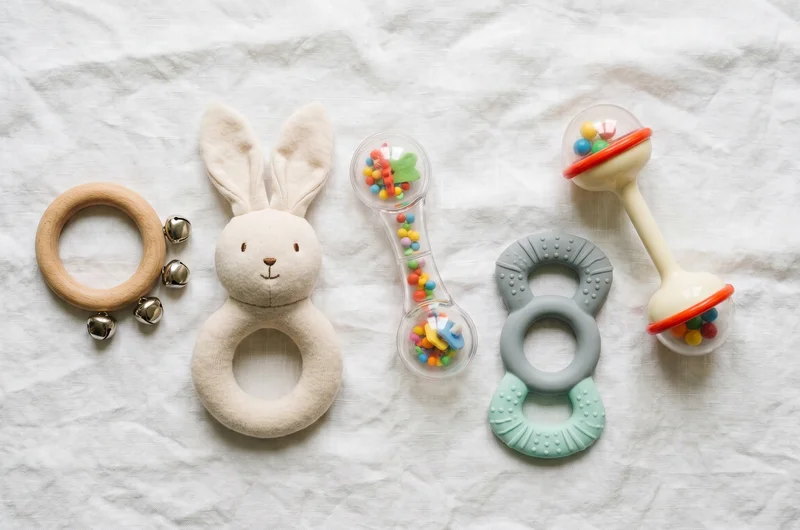
These are the rattles we'd genuinely buy, based on what we used with Freddie, what UK parents consistently rate, and which hold up over the four-to-six months of heavy use the rattle phase actually lasts.
What Makes a Good Baby Rattle? The Things to Actually Check
The baby rattle market is enormous and ranges from genuinely brilliant to actively dangerous. Here's what to look for and what to walk away from.
CE mark and EN71 compliance. In the UK and EU, any baby toy must carry the CE mark and comply with EN71 toy safety standards. This is non-negotiable. Don't buy unbranded rattles from unknown sellers without this certification — particularly from marketplace sites where counterfeit toys circulate.
Weight appropriate for the age. A newborn's arms are weak. A lightweight soft rattle is appropriate for a 6-week-old; a heavy wooden one is better from 4 months when muscle strength has developed enough to actually shake it.
No loose parts. Check that beads inside the rattle are sealed properly and can't escape. Shake it vigorously before giving it to your baby. Any loose rattle sounds — beyond the intended one — suggest the seal is compromised.
Sound level. Babies' hearing is sensitive. A loud clacking rattle is inappropriate for newborns. Soft jingling, gentle wooden rattling, and quiet beads are all fine. If it sounds genuinely loud to you, it's too much for a young baby.
Easy to clean. Everything babies hold goes in their mouths. Fabric rattles should be machine washable. Plastic and rubber ones should be wipe-clean or dishwasher-safe. Wooden rattles can usually be wiped with a damp cloth.
Wooden Baby Rattle — Why So Many Parents Choose Them
The wooden baby rattle is having a genuine moment. Not nostalgia for its own sake — actually for good reasons. Natural wood is durable, feels satisfying to hold, and ages far better than plastic. A good wooden rattle is still intact in ten years; a cheap plastic one is usually cracked or faded in six months.
There's also the sensory argument: wood has a warmth and weight to it that plastic simply doesn't. The sound a wooden rattle makes — a deeper, less tinny rattle than plastic — is genuinely nice. Some parents find the aesthetics matter too: a beautiful wooden rattle looks at home in a nursery in a way that a bright plastic toy doesn't.
The main consideration is age-appropriateness. Wooden rattles are heavier than fabric or basic plastic ones. For a newborn or a 2-month-old, a lightweight soft rattle is a better starting point. From around 4 months, when grip strength and arm coordination have developed, a wooden rattle is brilliant.
Brands to look for: HABA (German, excellent quality, widely available in the UK), Goki (similar quality tier, slightly more affordable), and various UK makers producing personalised engraved options that double as keepsakes.
Sensory Baby Rattle — More Than Just Noise
A sensory baby rattle does more than make a sound. The best ones combine audio, visual and tactile stimulation — babies hear the rattle, see the beads moving, feel the texture of the surface and discover that their own arm movement controls all of it. That's a lot of learning packed into one small toy.
The visual element is particularly important in the 3–6 month window when babies are fascinated by moving objects. A clear rattle with visible beads — like the Winkel or a traditional bell rattle — gives babies something to track visually as well as aurally. High-contrast colours (bright red, yellow, black, white) are processed most easily by babies whose visual systems are still developing.
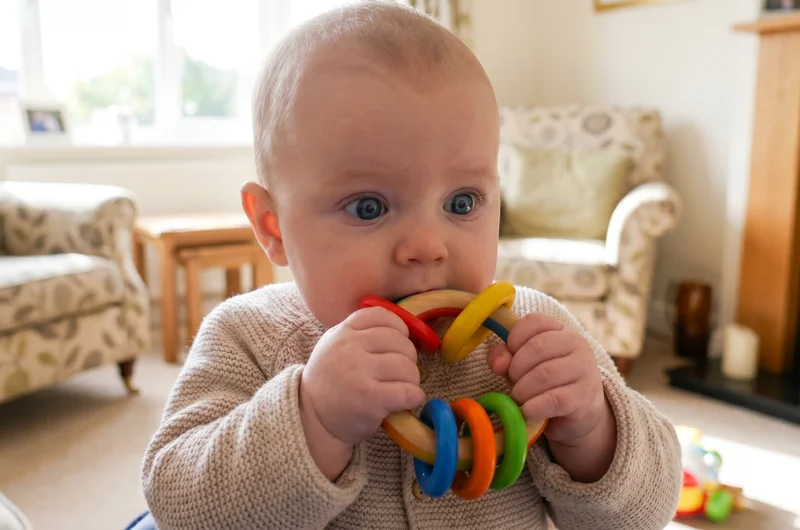
Wrist rattles take the sensory experience even further because they add a proprioceptive dimension — babies feel the weight on their wrist as well as hearing and seeing the result of their movement. It's one of the earliest ways babies understand that their body is theirs to control. Which is a lot to credit to a small fabric strap with a bell inside it, but genuinely accurate.
Baby Rattle as a New Baby Gift
A high-quality baby rattle is one of the most thoughtful and genuinely useful new baby gifts. It's the first toy most babies can actually interact with — not just look at, actually hold and shake and respond to — and it's compact, practical and almost always appreciated.
The key is choosing one that feels considered rather than generic. A personalised wooden baby rattle with the baby's name engraved is genuinely lovely — it's both a first toy and a keepsake, and it's the kind of thing parents keep long after it's outgrown. A Jellycat soft rattle is a brilliant option if you want something tactile and beautiful without personalisation. Sophie la Girafe needs no introduction — she's a classic for a reason and parents are always glad to receive her.
Avoid cheap rattles from pound shops or unknown brands without CE marking — they're not safe. The price difference between a decent rattle and a poor one is usually under £10 and completely worth it. For more new baby gift ideas, see our guides to personalised baby gifts, baby shower gifts and congratulations on your new baby.
Are Baby Rattles Safe? What UK Parents Need to Know
Baby rattles sold by reputable brands in the UK are safe — provided you're buying from legitimate sellers and checking for the right certifications. Here's what to look for and what to watch for.
CE mark: Required on all baby toys sold in the UK and EU. Any toy without it shouldn't be given to a baby, full stop.
EN71 compliance: The European toy safety standard. Reputable brands will state this on packaging or in product descriptions. It covers physical safety (no sharp edges, no detachable small parts), chemical safety (no toxic paints or materials) and flammability.
Age guidelines: Always follow the manufacturer's recommended age. A rattle with small parts might be CE marked but rated 12 months+ — it's not appropriate for a 3-month-old who puts everything in their mouth.
Choking hazard check: Any small part that could detach is a choking hazard. Before giving a rattle, shake it vigorously — if anything rattles beyond the intended internal beads, inspect it. Check seams on fabric rattles regularly as they can split with use.
Supervision: All babies should be supervised with rattles, particularly under 6 months. Not because good rattles are dangerous, but because babies at this age don't have the coordination to prevent things landing on their faces when they drop them.
Baby Rattle for Newborns — The First Six Weeks
A newborn can't hold a rattle. They can't reach for one, grab one, or shake one intentionally. What they can do is hear it, be startled by it (gently — not with a loud clatter), and begin to locate the source of the sound. That's a significant enough developmental activity to make a rattle worthwhile even in the very first weeks.
The right approach for 0–6 weeks is to shake a soft rattle gently about 30cm from your baby's face and watch them try to locate the sound. Move it slowly to one side and see if their eyes follow. It's one of the earliest ways to engage with your newborn's developing senses — and more interesting than it sounds when you start noticing progress from week to week.
Wrist rattles are the best option for independent use at this stage. Soft, washable, with no parts that can come off, they attach to the baby's wrist with a velcro strap and let babies discover cause and effect entirely by accident. Watch the expression the first time a baby shakes their arm, hears a jingle, and freezes — then very carefully does it again. It's one of the best things about the newborn phase.
For context on what other toys and sensory items work well alongside a newborn rattle, see our full guide to baby toys UK — including the black-and-white sensory cards and play gyms that work particularly well in the 0–3 month window.
When Does My Baby Outgrow a Rattle?
Most babies move on from rattles somewhere between 9 and 12 months — not because they stop liking the sound, but because more interesting toys have come along. By 9 months, babies are typically sitting independently, pulling to stand, and deeply interested in anything they can empty out, stack, push, open or close. A simple rattle can't compete with a stacking ring or an activity cube at that stage.
That said, babies are individuals. Some stay interested in rattles for longer — particularly if the rattle has multiple features (teething ring, interesting shapes, bright colours). A teething rattle can stay relevant until teeth have all come through at 12–18 months. A personalised keepsake rattle is often kept on the shelf indefinitely as a memento even if the toy phase ends.
If you're looking for what comes next after the rattle stage, our baby toys guide covers the 6–12 month window in detail — including the activity centres, soft blocks and sensory books that tend to dominate that stage.
And if a rattle is part of a broader baby keepsakes collection — alongside a memory book, footprint kit or keepsake box — it's worth keeping even after it's outgrown. The small things often matter most looking back.